
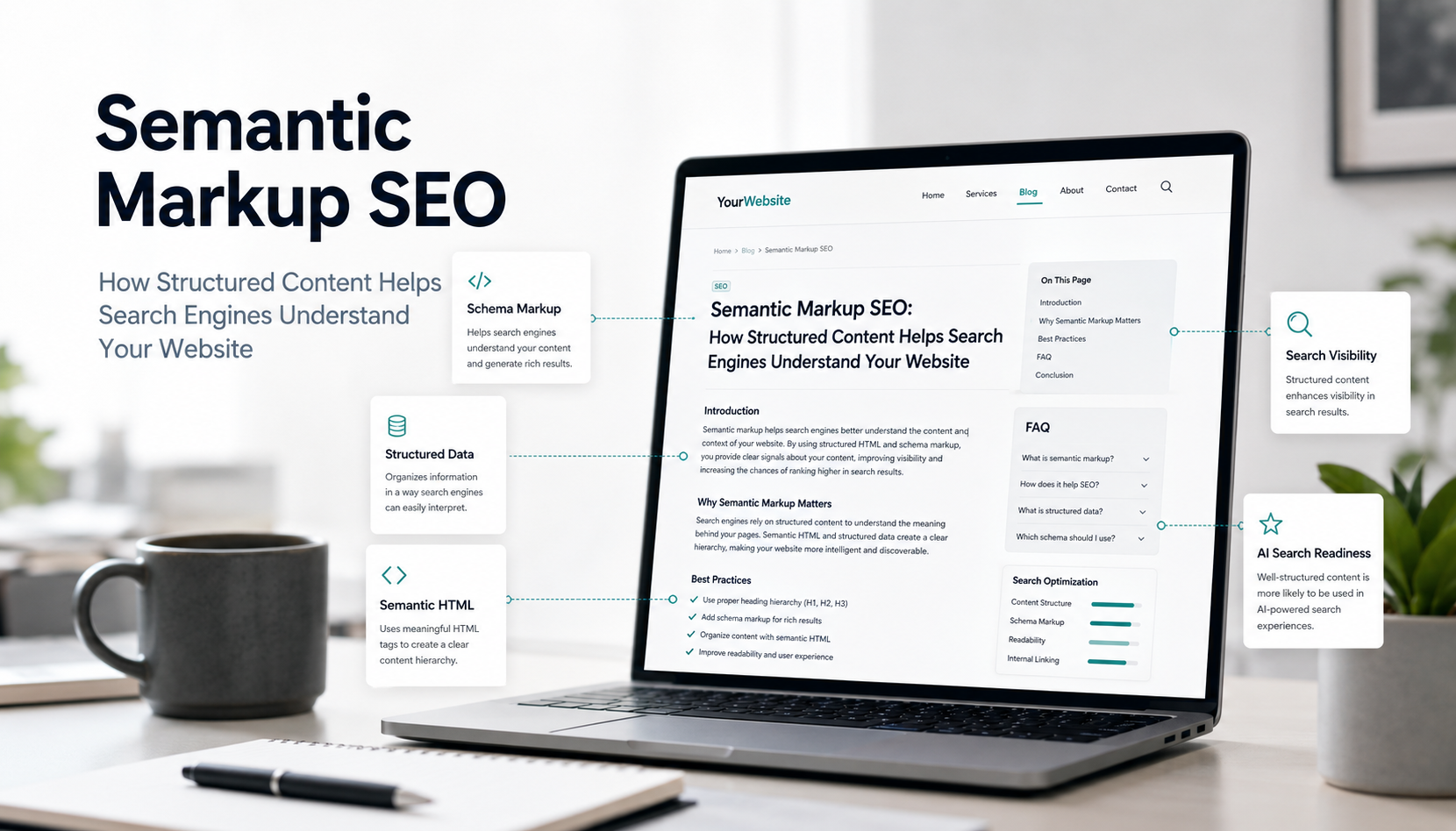
Introduction
Search engines have become much smarter over the last decade. Gone are the days when simply repeating keywords across a page was enough to achieve strong rankings. Today, Google and AI-powered search platforms focus on understanding the meaning, context, and structure of content.
This is where Semantic Markup SEO comes into play.
Semantic markup helps search engines understand what your content is about, how different elements on a page relate to one another, and which information is most important. As search evolves toward AI-driven experiences, semantic markup is becoming an essential part of modern SEO strategies.
Whether you’re managing a business website, an eCommerce store, or a service-based platform, understanding semantic markup can help improve visibility, enhance user experience, and strengthen your overall SEO performance.
In this guide, we’ll explore what semantic markup SEO is, why it matters in 2026, and how businesses can use it to build a stronger foundation for organic growth.
What Is Semantic Markup SEO?
Semantic markup SEO refers to the practice of using meaningful HTML elements and structured content to help search engines better understand the context of a webpage.
Instead of relying solely on keywords, semantic markup provides clues about the purpose of different content sections.
For example:
- <header>identifies the page header.
- <article>indicates primary content.
- <section>groups related information.
- <footer>defines the bottom section of a page.
- Structured headings organize content hierarchy.
These elements create a clearer structure that benefits both users and search engines.
In simple terms, semantic markup helps search engines interpret content more accurately rather than simply reading words on a page.
Why Semantic Markup SEO Matters in 2026
Search algorithms are increasingly focused on context and meaning.
Google’s goal is not just to index pages but to understand them.
At the same time, AI-powered search experiences such as Google AI Overviews, ChatGPT, Gemini, and Perplexity rely heavily on structured and clearly organized content.
When a page uses semantic markup correctly, it becomes easier for search engines to:
- Understand page structure
- Identify important topics
- Interpret relationships between content sections
- Generate richer search results
- Extract answers for AI-generated responses
As search becomes more conversational, websites with strong semantic foundations are likely to gain a competitive advantage.
Semantic Markup SEO vs Traditional SEO
Many businesses still associate SEO primarily with keywords and backlinks.
While these remain important, semantic markup adds another layer of optimization.
| Traditional SEO | Semantic Markup SEO |
| Focuses on keywords | Focuses on content meaning |
| Optimizes individual pages | Improves content understanding |
| Targets search rankings | Supports search understanding and AI visibility |
| Relies heavily on keyword relevance | Relies on context and structure |
The most effective SEO strategies combine both approaches.
Key Elements of Semantic Markup SEO
Proper Heading Structure
One of the simplest forms of semantic markup is using headings correctly.
A page should contain:
- One H1 tag
- Logical H2 sections
- Supporting H3 and H4 headings when necessary
This structure helps search engines understand the hierarchy of information.
Meaningful HTML Elements
Semantic HTML provides context.
Examples include:
- Header
- Nav
- Main
- Article
- Section
- Aside
- Footer
These elements improve accessibility while also helping search engines interpret content more effectively.
Structured Content Organization
Search engines prefer content that is easy to understand.
Well-organized content includes:
- Clear introductions
- Descriptive headings
- Bullet points
- FAQs
- Logical content flow
This not only improves SEO but also enhances user experience.
Schema Markup Integration
Although semantic markup and schema markup are different concepts, they work well together.
Schema provides additional information about:
- Businesses
- Services
- Products
- Reviews
- FAQs
- Articles
This helps search engines generate rich results and understand content more deeply.
How Semantic Markup Supports AI Search
One of the biggest shifts in SEO is the rise of AI-powered search experiences.
AI systems don’t simply look for keywords. They look for:
- Context
- Relationships
- Intent
- Structure
Semantic markup provides the framework that helps AI interpret content accurately.
For example, when AI systems analyze a page discussing Semantic Markup SEO, they can more easily identify definitions, explanations, examples, and supporting information when the content is properly structured.
This increases the chances of being referenced in AI-generated answers.
Common Semantic Markup SEO Mistakes
Many websites unintentionally make structural mistakes that limit their SEO potential.
Common issues include:
Using Headings Incorrectly
Skipping heading levels or using headings purely for design can confuse search engines.
Poor Content Organization
Large blocks of text without clear sections reduce readability.
Over-Reliance on Keywords
Keyword optimization remains important, but context and structure matter just as much.
Ignoring Schema Opportunities
Many websites miss opportunities to enhance search visibility through structured data.
How Semantic Markup Fits Into a Modern SEO Strategy
Semantic markup should not be viewed as a standalone tactic.
It works best as part of a broader SEO strategy that includes:
- Technical SEO
- Content optimization
- Internal linking
- User experience improvements
- Structured data implementation
- Topical authority development
Businesses investing in SEO today are increasingly focusing on creating content that is not only optimized for search engines but also understandable for AI systems and users alike.
This is why semantic markup has become an important consideration within modern SEO services and technical optimization efforts.
Practical Steps to Improve Semantic Markup SEO
If you’re looking to strengthen your website’s semantic structure, start with these steps:
- Audit your heading hierarchy.
- Replace non-semantic HTML where appropriate.
- Organize content into logical sections.
- Add FAQ sections where relevant.
- Implement schema markup.
- Improve internal linking between related topics.
- Ensure pages have clear topical focus.
Small structural improvements can make a significant difference over time.
Final Thoughts
As search engines continue evolving, Semantic Markup SEO is becoming increasingly important for websites that want to remain competitive.
While keywords and backlinks still play a major role, modern SEO is also about helping search engines understand content more effectively. Semantic markup creates the structure and context needed for both traditional search engines and emerging AI-powered platforms.
Businesses that invest in properly structured content, semantic HTML, and technical SEO best practices are better positioned to improve visibility, support AI search discovery, and create stronger user experiences.
In a digital landscape where understanding matters just as much as ranking, semantic markup is no longer just a technical consideration, it’s an essential part of a future-ready SEO strategy.