
Search is moving beyond the traditional experience of typing a query into Google, opening a list of results, and choosing a website. AI systems can now research across multiple sources, compare information, interpret user preferences, and increasingly perform multi-step tasks on a user’s behalf. This shift is creating a new consideration for digital marketers: how should websites prepare for AI agents that don’t simply return links but help users make decisions and complete tasks?
This is where Agentic SEO comes into the conversation.
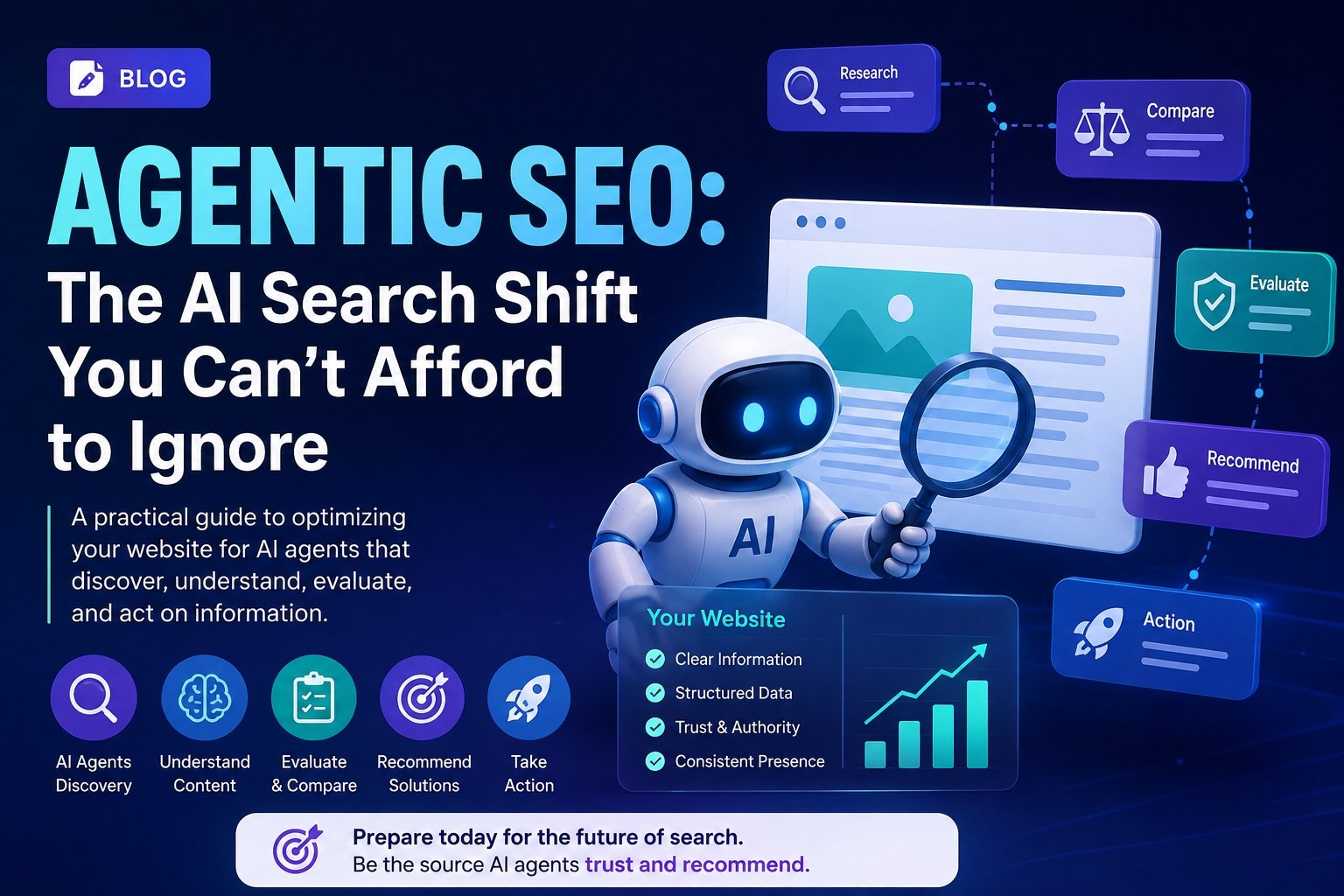
Agentic SEO focuses on making a website and its information easier for AI-driven systems to discover, understand, evaluate, and use when responding to complex user requests. It builds on traditional SEO rather than replacing it, extending familiar principles such as crawlability, clear content, structured information, entities, authority, and user experience into an increasingly agent-driven search environment.
But there is an important distinction: Agentic SEO is an emerging industry concept, not an officially published Google ranking factor. The practical strategies should therefore be treated as an extension of good SEO and AI-search readiness not as a secret algorithm checklist.
What Is Agentic SEO?
Agentic SEO is the practice of preparing a website’s content, information, technical structure, and digital presence so AI agents can more easily discover, interpret, evaluate, and use that information.
An AI agent differs from a traditional search experience because it can potentially perform several steps instead of simply returning search results.
For example, a user might ask:
“Find three Shopify agencies that can build a fashion store, compare their services, check their credibility, and recommend the best option.”
A traditional search journey might produce:
Query → Search results → Website → Human research
An agentic journey can involve:
User request → Search → Multiple sources → Evaluation → Comparison → Recommendation → Potential action
Research into agentic search describes systems that can issue multiple searches, retrieve information, evaluate results, and adapt their search process rather than relying on a single query.
That changes what “visibility” can mean.
A website may not always need to be the first blue link. Its information may need to be understandable and trustworthy enough to become part of an AI-generated recommendation or decision.
Agentic SEO vs SEO, AEO and GEO
These concepts overlap, but they aren’t identical.
Traditional SEO
The primary objective is to improve a website’s visibility in search engines and attract organic visitors.
Search engine → Results → Human → Website
AEO
Answer Engine Optimization focuses on making information suitable for direct answers, particularly when users expect concise responses.
Question → Answer system → Answer
GEO
Generative Engine Optimization focuses on improving the likelihood that a brand or source is represented, mentioned, or cited within generative AI responses.
Question → Generative AI → Synthesized response + sources
Agentic SEO
Agentic SEO takes this further by considering AI systems that can research, compare, evaluate, and potentially act.
User goal → AI agent → Research → Evaluation → Decision/action
So Agentic SEO isn’t necessarily a replacement for SEO, AEO, or GEO.
Think of it as another layer on top of the search ecosystem.
How Do AI Agents Understand a Website?
An AI agent needs more than a keyword to understand a business.
It may need to determine:
- What the company does
- Which products or services it offers
- Who it serves
- Where it operates
- Whether information is current
- Whether claims are supported
- How the business compares with alternatives
- Whether the information is trustworthy
This is why entity SEO and semantic SEO become particularly useful.
For example, instead of repeatedly writing:
Shopify expert, Shopify expert, Shopify expert
a website should clearly establish relationships between entities such as:
CreatorStudio99 → Shopify → Ecommerce → Store Development → Shopify Themes → Conversion Optimization
The objective is not keyword repetition.
It’s meaning and context.
10 Practical Agentic SEO Strategies
1. Make Your Business Entity Clear
Clearly explain:
- Who you are
- What you offer
- Who you serve
- Where you operate
- Your expertise
- Your products or services
Maintain consistent business information across your website and important external sources.
An AI system comparing several companies has a much easier job when your identity and offerings are clearly defined.
2. Build Strong Topical Authority
Don’t publish dozens of unrelated articles just because keywords have search volume.
Build connected topic clusters.
For example, a Shopify-focused website might cover:
Shopify Themes
↓
Shopify Store Development
↓
Shopify SEO
↓
Shopify CRO
↓
Shopify Conversion Optimization
↓
Shopify Store Management
This creates a stronger semantic relationship between the site’s content.
3. Make Important Information Easy to Extract
Avoid hiding essential information inside vague marketing copy.
Instead of:
“We provide innovative digital solutions tailored to modern businesses.”
Say:
“We provide Shopify store development, Shopify theme customization, and ecommerce website management for online businesses.”
The second statement is much easier to understand and reuse accurately.
4. Use Structured Data Where Appropriate
Structured data helps search engines understand the entities and information represented on a page.
Depending on the website, useful Schema.org types may include:
- Organization
- Product
- Article
- BreadcrumbList
- LocalBusiness
- Person
- Review
Structured data should accurately represent visible page content. It isn’t a shortcut for making an AI system rank a page.
5. Keep Information Consistent
Imagine your website says:
“We offer Shopify development.”
Your LinkedIn profile says:
“We specialize in WordPress.”
A directory says:
“We are primarily an SEO company.”
And another page says:
“We sell Shopify templates.”
An AI system trying to understand your business has conflicting signals.
Consistency matters.
Make sure your:
Website + profiles + directories + publications + author information
tell a coherent story.
6. Create Content That Answers Complete Questions
AI systems often need context rather than isolated sentences.
Instead of:
“CRO improves conversions.”
Explain:
“Conversion Rate Optimization (CRO) is the process of improving a website or landing page to increase the percentage of visitors who complete a desired action, such as submitting a form, purchasing a product, or booking a consultation.”
The second statement is self-contained.
That’s useful when information is retrieved outside its original page context.
7. Strengthen First-Hand Experience and Evidence
Don’t just make claims.
Demonstrate expertise through:
- Case studies
- Original research
- Examples
- Screenshots
- Before-and-after results
- Author expertise
- Client experiences
- Methodologies
- Data
This connects directly with the Experience component of E-E-A-T.
A generic article saying “we are experts” is weaker than an article demonstrating how the company solved a real problem.
8. Keep Important Information Current
AI-driven systems may encounter outdated pages alongside current ones.
Review information such as:
- Pricing
- Services
- Product specifications
- Company details
- Contact information
- Features
- Statistics
- Industry claims
Add meaningful update dates where appropriate.
Don’t change the date simply to make old content appear fresh.
9. Make Your Website Technically Accessible
An agent can’t use information it cannot retrieve.
Continue doing the fundamentals:
- Crawlable pages
- Logical internal linking
- Fast loading
- Mobile usability
- Proper HTTP status codes
- Accessible content
- Clear navigation
- No accidental blocking of important resources
This is one reason Agentic SEO shouldn’t be treated as a replacement for technical SEO.
Good technical SEO remains foundational.
10. Think Beyond the Website
This may become one of the most important areas of Agentic SEO.
AI systems don’t necessarily understand a business from its homepage alone.
They can encounter information from:
- Industry publications
- Reviews
- Forums
- Social platforms
- Business directories
- Product databases
- News articles
- Expert authors
- Third-party websites
Recent research and industry analysis around agentic search emphasize that AI systems can research and cross-reference information from multiple sources before producing an answer.
So your overall digital presence matters.
What Makes a Website “Agent-Ready”?
Think of an agent-ready website as one where an AI system can answer these questions quickly:
Who are you?
Clearly defined entity.
What do you offer?
Clearly defined products/services.
Who is it for?
Clearly defined audience.
Why should someone trust you?
Evidence, experience, authority.
Where can your claims be verified?
Consistent external sources.
What should the user do next?
Clear actions and pathways.
That’s a much better framework than simply asking:
“Did I use my keyword enough?”
Common Agentic SEO Mistakes
Mistake 1: Treating Agentic SEO as another keyword strategy
Adding “AI agent” to dozens of pages doesn’t make a website agent-ready.
The objective is understanding and usefulness, not keyword stuffing.
Mistake 2: Believing there is a secret Agentic SEO ranking factor
There isn’t an established Google ranking factor officially called “Agentic SEO.”
Be cautious whenever someone sells a guaranteed “agentic ranking formula.”
Mistake 3: Publishing AI-generated content at scale
AI agents make content production easier, but producing hundreds of generic pages doesn’t automatically create authority.
Google’s guidance continues to emphasize helpful, reliable, people-first content rather than content created primarily to manipulate search rankings.
Mistake 4: Ignoring traditional SEO
Agentic SEO doesn’t mean:
“Forget Google.”
Crawlability, indexing, quality content, links, site architecture, structured data, and user experience remain important foundations.
Agentic SEO Checklist
Before considering your website ready for an agent-driven search environment, ask:
Content
☐ Are important questions answered clearly?
☐ Is the information self-contained?
☐ Does the content provide original value?
Entity
☐ Is the business clearly defined?
☐ Are services/products clearly described?
☐ Is business information consistent?
Technical
☐ Can search engines crawl important pages?
☐ Is internal linking logical?
☐ Is structured data implemented correctly where appropriate?
☐ Does the site work well on mobile?
Trust
☐ Are authors identifiable?
☐ Is experience demonstrated?
☐ Are claims supported?
☐ Are important external references consistent?
AI search
☐ Is your brand represented accurately across the web?
☐ Are your important products/services easy to understand?
☐ Can an AI system distinguish your business from competitors?
How Agentic SEO Connects With AEO and GEO
This is where everything we’ve been learning comes together.
Think about the progression:
SEO
Help search engines discover and rank your website.
↓
AEO
Help answer systems understand and answer questions using your information.
↓
GEO
Improve your chances of being represented or cited in generative AI responses.
↓
Agentic SEO
Prepare your digital presence for AI systems that can research, evaluate, compare, and potentially act on information.
These aren’t four completely separate worlds.
They’re increasingly overlapping parts of the same search ecosystem.
Final Thoughts
Agentic SEO represents an important shift in how we think about search visibility.
The goal is no longer only to ask:
“How do I get my page to rank for this keyword?”
We increasingly need to ask:
“Can an AI system understand who we are, what we offer, why we’re trustworthy, and when our information is relevant to a user’s goal?”
That’s the fundamental idea behind Agentic SEO.
But don’t treat it as a replacement for traditional SEO, AEO, or GEO. The strongest strategy is to build on the fundamentals: technically accessible websites, useful content, clear entities, semantic relationships, genuine expertise, consistent information, and evidence that people can trust.
As AI systems become better at researching and completing multi-step tasks, websites that make their information clear, verifiable, current, and actionable will be better positioned for the next stage of search. Research into agentic search is already treating AI agents as a distinct emerging search user, while industry SEO research is beginning to develop practical frameworks around this shift.
The future of SEO may not simply be about ranking a page. It may increasingly be about becoming a source an AI agent can confidently understand and use.
Frequently Asked Questions
What is Agentic SEO?
Agentic SEO is an emerging approach to optimizing a website and digital presence so AI agents can more easily discover, understand, evaluate, and use its information.
Is Agentic SEO a Google ranking factor?
No. There is no officially documented Google ranking factor called “Agentic SEO.” It is an emerging industry concept built around the evolution of AI-driven search and agentic systems.
Is Agentic SEO the same as GEO?
No. GEO generally focuses on visibility within generative AI responses, while Agentic SEO considers a broader environment in which AI systems may research, compare, evaluate, and potentially act on information.
Does structured data help with Agentic SEO?
Structured data can provide clearer machine-readable information about entities and content. However, it should be implemented correctly and should not be treated as a guaranteed way to make an AI agent recommend a website.
Do I need a completely new SEO strategy for AI agents?
Not necessarily. Strong technical SEO, useful content, clear entities, structured information, authority, and good user experience remain foundational. Agentic SEO extends these principles toward newer AI-driven search experiences.