
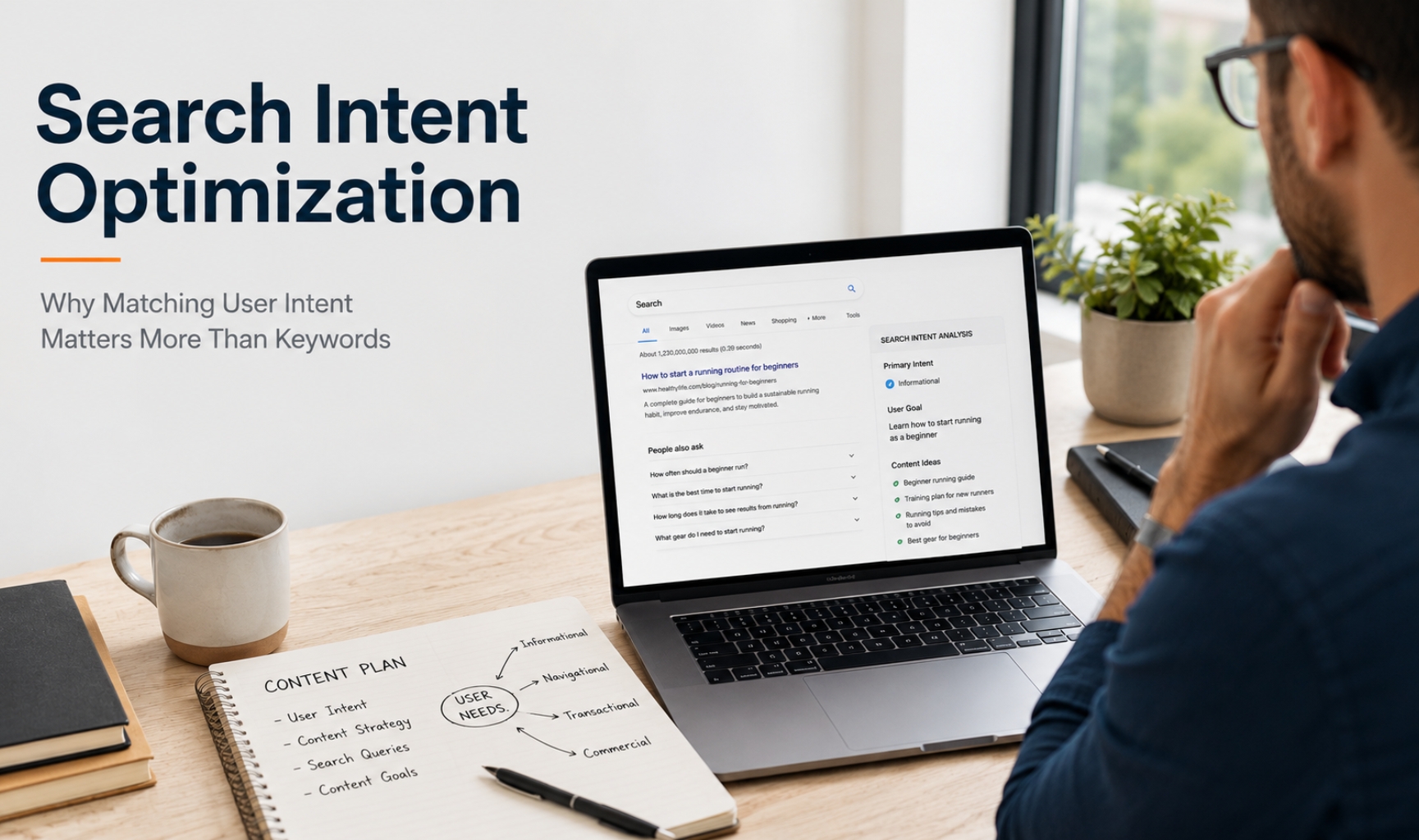
For years, SEO was largely driven by keywords.
Find a keyword, include it in your content, build a few backlinks, and hope to rank. While keywords still matter, search engines have evolved significantly. Today, Google’s primary goal is not to match words; it is to satisfy users.
This shift has made Search Intent Optimization one of the most important SEO strategies in 2026.
Many websites struggle to rank not because their content is poorly written, but because it doesn’t align with what users actually want. Even well-optimized pages with strong backlinks can fail if they miss the intent behind a search query.
In this guide, you’ll learn what search intent optimization is, why it matters more than ever, and how businesses can create content that aligns with both search engines and real users.
What Is Search Intent Optimization?
Search Intent Optimization is the process of creating content that matches the reason behind a user’s search query.
When someone searches on Google, they have a specific goal in mind. They may be looking for information, comparing options, finding a website, or making a purchase.
Google’s job is to deliver the most relevant result based on that goal.
Search Intent Optimization focuses on understanding those goals and creating content that fulfills them better than competing pages.
Instead of asking:
“What keyword should I target?”
Modern SEO asks:
“What is the user trying to achieve?”
This shift is one of the biggest reasons why some pages outrank competitors with stronger backlink profiles.
Why Search Intent Matters More Than Keywords
Imagine someone searches:
WordPress Website Design Company
What do they want?
They probably want:
- Service providers
- Pricing information
- Portfolio examples
- Client reviews
- Contact details
Now imagine a website ranks for that keyword with a blog explaining the history of WordPress.
The content may be well-written, but it doesn’t satisfy the user’s goal.
Google recognizes this mismatch.
As a result, pages that closely align with search intent are more likely to rank, earn engagement, and generate conversions.
Keywords help search engines understand the topic.
Search intent helps search engines understand the purpose.
The Four Main Types of Search Intent
Informational Intent
Users want answers, explanations, or education.
Examples:
- What is Semantic SEO?
- How does schema markup work?
- What is Search Intent Optimization?
The goal is learning.
Navigational Intent
Users are looking for a specific website or brand.
Examples:
- Shopify login
- WordPress dashboard
- Google Search Console
The goal is reaching a known destination.
Commercial Intent
Users are researching options before making a decision.
Examples:
- Best Shopify themes
- SEO agency reviews
- WordPress website design company
The goal is evaluation and comparison.
Transactional Intent
Users are ready to take action.
Examples:
- Buy Shopify theme
- Hire SEO consultant
- SEO services near me
The goal is conversion.
Understanding which category a keyword belongs to is the first step in search intent optimization.
Why Good Content Still Fails to Rank
One of the biggest misconceptions in SEO is that better content automatically wins.
In reality, content can fail even when it has:
- Strong writing
- Good backlinks
- Proper keyword usage
- Technical optimization
The reason is often simple:
Intent mismatch.
For example, if users searching for “best SEO tools” want comparisons and pricing details, but your article only explains what SEO tools are, Google may prefer another page that satisfies the searcher’s needs more effectively.
This is why matching intent often matters more than producing longer content.
Search Intent Drift: The SEO Factor Most Websites Ignore
Search intent isn’t fixed.
It changes over time.
This concept is known as Search Intent Drift.
For example:
A few years ago, users searching for:
Best SEO Tools
wanted lists and recommendations.
Today, they may also expect:
- AI capabilities
- Automation features
- Real-world comparisons
- Updated pricing
As user expectations change, Google updates its rankings to reflect those expectations.
This is one reason why content updates are essential for long-term SEO success.
If rankings decline, the issue may not be content quality, it may be changing search intent.
Intent Layering: Understanding Hidden User Goals
Most SEO guides treat search intent as a single category.
Real searches are often more complex.
Consider the keyword:
Shopify Themes
Primary Intent:
Commercial
Secondary Intent:
Informational
Hidden Intent:
Trust and confidence
Users don’t just want theme recommendations.
They want to know:
- Which themes perform best
- Which themes are reliable
- Which themes improve conversions
Pages that satisfy multiple layers of intent often perform better because they provide a more complete user experience.
How Search Intent Supports AI Search
Search is no longer limited to traditional search engines.
AI-powered platforms such as ChatGPT, Google AI Overviews, Gemini, and Perplexity are increasingly helping users find information.
These systems focus heavily on intent.
They analyze:
- Questions
- Context
- User goals
- Content relevance
This means Search Intent Optimization isn’t just about Google rankings anymore.
It’s also becoming an important part of Answer Engine Optimization (AEO) and Generative Engine Optimization (GEO).
Businesses that understand user intent are more likely to appear in AI-generated responses.
The Search Intent Validation Framework
Before creating content, use this simple framework.
1. What is the user trying to achieve?
Identify the end goal behind the search.
2. What type of content currently ranks?
Analyze page-one results.
Are they:
- Blog posts?
- Service pages?
- Product pages?
- Comparison articles?
Google often reveals intent through existing rankings.
3. What format dominates search results?
Users may prefer:
- Guides
- Lists
- Tutorials
- Reviews
Matching format is often just as important as matching topic.
4. What questions keep appearing?
Look for:
- Related searches
- FAQs
- People Also Ask results
These provide valuable clues.
5. What would completely satisfy the searcher?
The best content doesn’t simply answer questions.
It eliminates the need for further searching.
Search Intent and Conversion Rates
Many businesses focus exclusively on traffic.
Traffic alone doesn’t generate revenue.
Intent drives conversions.
For example:
A page targeting users who are actively researching SEO services will often generate more leads than a page targeting broad informational traffic.
This is why modern SEO strategies focus on attracting the right visitors rather than simply increasing visitor numbers.
Businesses investing in professional SEO services often prioritize search intent analysis because it helps connect rankings with real business outcomes.
Common Search Intent Optimization Mistakes
Focusing Only on Keywords
Keywords are important, but they don’t reveal the full story.
Ignoring Search Result Analysis
Google already provides clues about intent through ranking pages.
Ignoring these clues is a common mistake.
Creating Content Without User Research
Understanding your audience should always come before content creation.
Not Updating Content
Search intent evolves.
Content should evolve with it.
The Future of Search Intent Optimization
As search engines become smarter, understanding intent will become even more important.
Future SEO success will depend less on keyword frequency and more on:
- User satisfaction
- Context
- Content relevance
- Topic coverage
- AI compatibility
Search engines are moving closer to understanding why people search, not just what they search.
Websites that adapt to this shift will have a significant competitive advantage.
Final Thoughts
Search Intent Optimization is no longer an advanced SEO tactic, it’s a fundamental requirement for ranking in modern search results.
While keywords help search engines identify a topic, search intent helps them determine whether a page truly satisfies the user’s needs.
Businesses that focus on understanding user goals, aligning content with intent, and continuously adapting to changing search behavior are better positioned to succeed in both traditional and AI-powered search environments.
In 2026, the question is no longer:
“Did you target the keyword?”
It’s:
“Did you solve the user’s problem?”
The websites that answer that question effectively are the ones most likely to earn visibility, traffic, and long-term SEO success.