
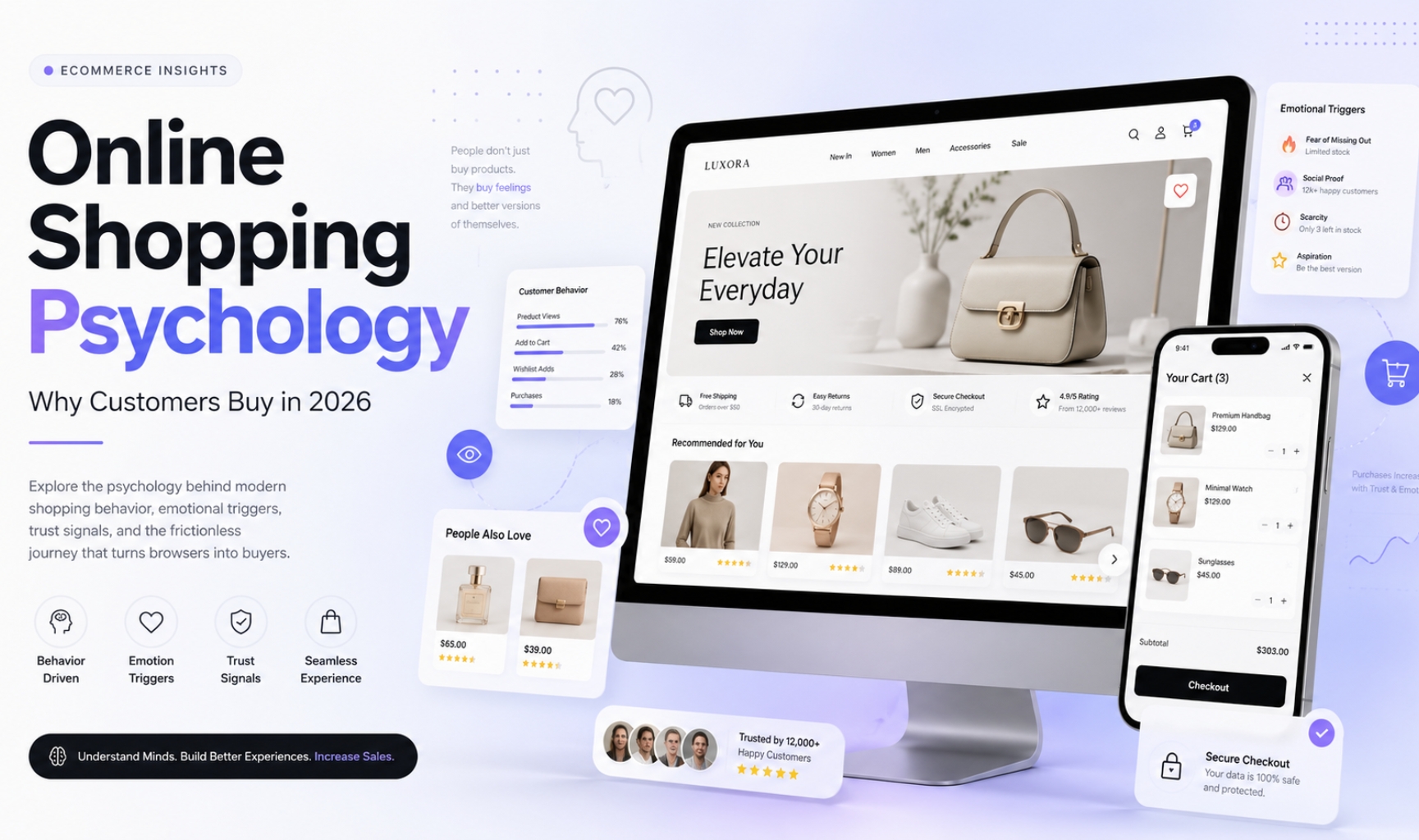
Online shopping has become more than just a convenient way to purchase products. In 2026, it is deeply connected to psychology, emotions, trust, and behavior.
Customers no longer buy products simply because they need them. They buy because of how a website makes them feel.
That is why understanding Online Shopping Psychology has become one of the most important parts of building a successful eCommerce business.
From website design and product presentation to colors, speed, and customer trust, every detail influences buying decisions in subtle ways. The brands that understand these behaviors are often the ones that convert visitors into loyal customers more effectively.
Modern eCommerce is no longer only about selling products. It is about creating experiences that feel smooth, comfortable, and emotionally convincing.
What Is Online Shopping Psychology?
Online Shopping Psychology refers to the study of how people think, behave, and make purchasing decisions while shopping online.
It focuses on:
- customer emotions
- buying behavior
- trust patterns
- decision-making habits
- visual influence
- user experience
The goal is to understand why customers buy, what makes them hesitate, and what influences them to complete a purchase.
In many cases, buying decisions happen emotionally first and logically second.
First Impressions Influence Buying Decisions Quickly
When users land on a website, they immediately begin forming opinions.
Within seconds, customers often judge:
- professionalism
- trustworthiness
- product quality
- brand value
This happens before they even read product details.
A cluttered or outdated website can create doubt almost instantly. On the other hand, clean layouts and organized design structures make stores feel more trustworthy and premium.
Modern brands are increasingly focusing on:
- minimal layouts
- cleaner interfaces
- stronger visual hierarchy
- better spacing
- simplified navigation
These elements help customers feel more comfortable while browsing.
Customers Buy Emotionally More Than Logically
One of the biggest realities in Online Shopping Psychology is that emotions strongly influence purchases.
People often buy products because they want to feel:
- confident
- excited
- secure
- stylish
- comfortable
- successful
Even technical purchases are influenced by emotion.
That is why successful eCommerce brands focus heavily on:
- storytelling
- visuals
- branding
- product presentation
Products that create emotional connection usually perform better than products that only provide information.
Trust Plays a Major Role in Online Purchases
Trust has become one of the strongest psychological factors in eCommerce.
Customers are naturally cautious while shopping online because they cannot physically interact with products.
That means websites must work harder to create confidence.
Strong trust-building elements include:
- customer reviews
- secure checkout badges
- professional design
- transparent policies
- clear product descriptions
- authentic photography
Even small trust signals can influence buying decisions significantly.
Modern online stores are also focusing more on smoother user experiences because good UX itself creates psychological comfort.
Website Speed Affects Customer Behavior
Customers expect websites to feel instant.
When pages load slowly, users often experience frustration without even realizing it consciously.
Slow websites create negative psychological reactions, such as:
- impatience
- uncertainty
- distrust
- reduced interest
Fast-loading websites feel:
- more professional
- more reliable
- easier to use
This is why performance optimization has become a major part of modern eCommerce strategy.
In many cases, speed directly affects conversions.
Visual Simplicity Reduces Mental Overload
Many online stores fail because they overwhelm users with too much information.
Customers do not want to process complicated layouts while shopping.
Clean and minimal designs work better because they reduce cognitive overload.
Modern Online Shopping Psychology studies show that users prefer:
- simpler navigation
- organized product pages
- readable content
- cleaner interfaces
Minimal design helps customers focus on products instead of distractions.
That is one reason many premium brands now use simpler layouts rather than flashy designs.
Social Proof Influences Customer Confidence
People naturally trust other people.
That is why social proof remains one of the strongest psychological triggers in eCommerce.
Examples of social proof include:
- customer reviews
- ratings
- testimonials
- user-generated content
- influencer mentions
- customer photos
When users see others purchasing or recommending products, they feel more comfortable making decisions themselves.
This reduces hesitation and improves confidence during the shopping process.
Mobile Shopping Behavior Has Changed Online Stores
Most online shopping now happens through smartphones.
Mobile users behave differently compared to desktop users
That means modern eCommerce websites must prioritize:
- responsive design
- thumb-friendly navigation
- simplified layouts
- fast checkout processes
If mobile experiences feel frustrating, customers leave quickly.
Good mobile UX directly supports better customer psychology and engagement.
Product Presentation Shapes Perceived Value
Customers often judge product quality based on presentation rather than technical details alone.
High-quality product visuals, clean layouts, and strong branding can psychologically make products feel more premium.
Effective product pages usually include:
- professional imagery
- clear pricing
- concise descriptions
- multiple product angles
- lifestyle visuals
The way products are displayed influences how valuable they appear to customers.
This is why visual presentation plays such a large role in conversions.
Personalization Is Becoming More Important
Modern customers expect more personalized shopping experiences.
Brands are increasingly using:
- personalized recommendations
- recently viewed products
- customized offers
- behavioral targeting
Personalization makes users feel understood, which improves engagement and customer satisfaction.
As AI tools continue evolving, personalization is becoming a larger part of Online Shopping Psychology strategies.
Human-Centered Design Is the Future of eCommerce
One noticeable trend in 2026 is the shift toward more human-centered digital experiences.
Customers are responding better to websites that feel:
- authentic
- relatable
- emotionally comfortable
Many businesses are now reducing overly aggressive marketing styles and focusing more on:
- softer branding
- natural messaging
- cleaner storytelling
- realistic visuals
Some modern brands also study platforms like creatorstudio99 to understand better how clean eCommerce layouts and user-focused experiences are structured for today’s shoppers.
The focus is shifting toward experiences that feel less corporate and more customer-friendly.
Final Thoughts
Understanding Online Shopping Psychology is becoming essential for modern eCommerce businesses.
Customers do not simply buy products anymore. They respond to:
- emotions
- trust
- design
- speed
- branding
- usability
- overall experience
The stores that understand customer behavior are often the ones that create stronger engagement and higher conversions.
In 2026, successful eCommerce websites are not only selling products they are creating shopping experiences that feel natural, trustworthy, and emotionally rewarding.