
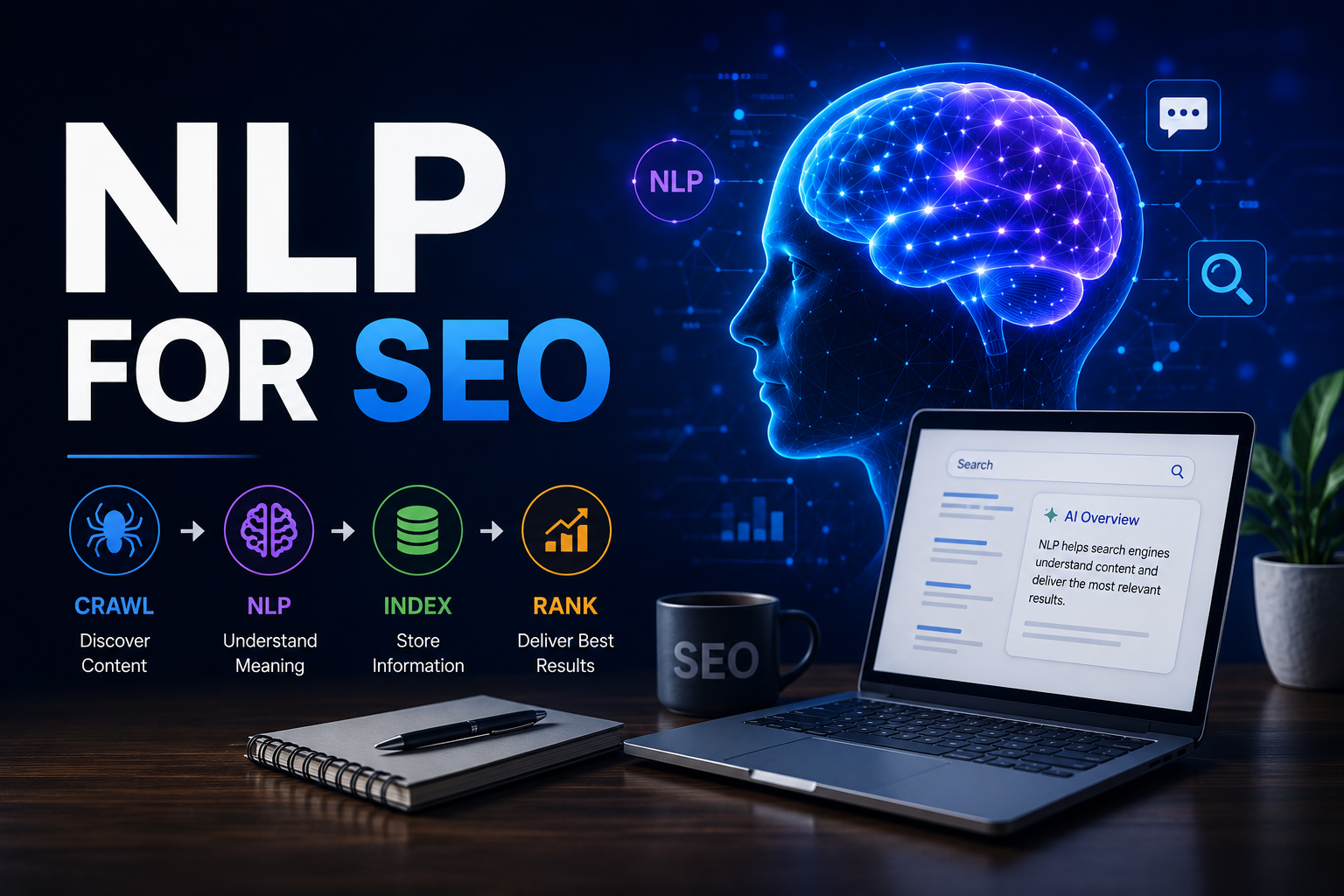
For years, SEO professionals focused on keywords, backlinks, and technical optimization to improve search rankings. While these factors remain important, Google’s search algorithms have become far more intelligent. Today, ranking well isn’t just about including the right keywords; it’s about helping search engines understand the meaning behind your content.
This is where Natural Language Processing (NLP) comes into play. NLP enables Google and AI-powered search engines to analyze human language, recognize context, identify entities, understand relationships, and determine whether your content truly answers a user’s query. Instead of asking, “Does this page contain the keyword?” Google now asks, “Does this page provide the best answer for the user’s intent?”
Understanding NLP for SEO is essential for anyone looking to improve organic rankings, appear in AI-powered search experiences, and create content that remains valuable as search technology evolves. In this guide, you’ll learn how NLP works, why it matters, and how you can optimize your content for both traditional search engines and AI-driven search platforms.
What Is NLP in SEO?
Natural Language Processing (NLP) is a branch of Artificial Intelligence that helps computers understand, interpret, and analyze human language.
In SEO, NLP allows search engines like Google to move beyond simple keyword matching and understand the actual meaning of a webpage. Instead of treating content as a collection of words, Google analyzes the relationships between concepts, identifies important entities, and determines whether the information satisfies the user’s search intent.
For example, consider these two sentences:
- Apple launched a new iPhone this year.
- An apple a day keeps the doctor away.
Both sentences contain the word Apple, but they refer to entirely different things. Thanks to NLP, Google understands that the first sentence refers to Apple Inc., while the second refers to the fruit. This ability to understand context is what makes modern search engines much more accurate than they were a decade ago.
Why Google Needs NLP
Imagine Google crawling billions of webpages every single day. If it relied only on keywords, it would struggle to distinguish between pages that genuinely answer a question and those that simply repeat the same terms.
NLP helps Google answer important questions such as:
- What is this page actually about?
- Which concepts are being discussed?
- How are these concepts connected?
- Does this content answer the user’s question?
- Is the information clear and trustworthy?
By understanding language instead of just matching words, Google can deliver more relevant and helpful search results.
This is one of the biggest reasons why modern SEO focuses on creating high-quality, context-rich content rather than keyword-heavy articles.
Crawler vs NLP: Google’s Eyes and Brain
One of the easiest ways to understand Google’s workflow is to compare it to a human.
Think of Google’s crawler as its eyes.
The crawler’s responsibility is simple: it discovers webpages by following links, XML sitemaps, and other signals across the internet. It collects information but doesn’t understand what the content means.
Once the crawler has found your page, Google’s Natural Language Processing systems begin their work.
Think of NLP as Google’s brain.
Its job is to understand your content by identifying:
- The primary topic
- Important entities
- Relationships between concepts
- User intent
- Overall context
Without the crawler, Google would never discover your page.
Without NLP, Google would discover your page but fail to understand what it actually explains.
This is why successful SEO depends on both discoverability and clarity.
AI Insight
The crawler finds your content. NLP understands your content. Ranking systems decide whether your content deserves to appear for a search query.
Each stage plays a different role, and all three are essential for successful SEO.
How NLP Understands Meaning
Humans naturally understand language because we recognize context.
For example, if someone says:
Meta Pixel helps businesses track website visitors.
You immediately understand that:
- Meta is the company.
- Meta Pixel is a tracking tool.
- Website visitors are the audience.
- Tracking refers to collecting user activity.
Google performs a similar process using NLP.
Instead of simply reading words one by one, it identifies entities and relationships to determine what the sentence actually means.
This allows Google to build a deeper understanding of your content rather than relying on exact keyword matches.
The more clearly you explain concepts and relationships, the easier it becomes for Google’s NLP systems to interpret your page.
NLP and Entity SEO
One of the most important concepts connected to NLP is Entity SEO.
An entity is a uniquely identifiable person, organization, place, product, event, or concept.
Examples include:
- Shopify
- Meta Pixel
- Core Web Vitals
- Search Engine Optimization
When your content clearly identifies these entities, NLP can interpret your content with greater accuracy.
For instance, writing:
Meta Pixel tracks browser-side events for websites.
is much clearer than writing:
Pixel tracks visitors.
The first sentence removes ambiguity by identifying the exact entity and explaining its purpose.
This is why Entity SEO has become one of the foundations of modern search optimization.
NLP and Semantic SEO
Semantic SEO is the practice of covering a topic comprehensively rather than focusing on a single keyword.
Suppose you’re writing about Technical SEO.
Instead of repeating the phrase “Technical SEO” throughout the article, you naturally discuss related concepts such as:
- XML Sitemap
- Robots.txt
- Canonical Tags
- Core Web Vitals
- HTTPS
- Structured Data
- Crawl Budget
Google’s NLP recognizes that these concepts are semantically connected.
As a result, your content appears more comprehensive and authoritative because it demonstrates expertise across the entire topic rather than just targeting one keyword.
Why NLP Is Essential for AI Search
As AI-powered search continues to evolve, understanding content has become even more important than matching keywords.
AI systems generate answers by retrieving information they understand with confidence. They prefer content that is:
- Clearly written
- Logically structured
- Rich in context
- Free from ambiguity
- Supported by recognizable entities
This is why optimizing for NLP also improves your chances of appearing in AI-driven search experiences such as AI Overviews, conversational search, and future Answer Engine Optimization (AEO) platforms.
Instead of writing solely for rankings, modern SEO focuses on making content easier for both humans and machines to understand.
Key Takeaway
The future of SEO isn’t about using more keywords; it’s about communicating meaning more effectively.
When you write clear definitions, explain relationships, identify important entities, and organize information logically, you’re helping Google’s NLP systems understand your expertise.
In the next part, we’ll explore how NLP connects with Google’s Knowledge Graph, Search Intent, AEO, and GEO, as well as practical optimization techniques that can help your content become more visible in both traditional search results and AI-powered search experiences.
Frequently Asked Questions
1. What is NLP in SEO?
Natural Language Processing (NLP) is an AI technology that helps Google understand the meaning behind your content rather than simply matching keywords. It analyzes context, entities, relationships, and user intent to determine how relevant a page is for a search query. This allows search engines to deliver more accurate and helpful results.
2. Why is NLP important for SEO?
NLP is important because modern search engines prioritize content that clearly answers user questions. Instead of rewarding keyword repetition, Google uses NLP to understand topics, identify entities, and evaluate whether your content satisfies search intent. This helps improve relevance and long-term organic visibility.
3. How does NLP differ from keyword-based SEO?
Traditional keyword SEO focuses on optimizing for exact search terms, while NLP focuses on understanding the meaning behind the content. Modern SEO combines both approaches—using keywords to target searches and NLP-friendly writing to help search engines understand context and relationships.
4. How can I optimize my content for NLP?
Create clear, well-structured content with descriptive headings, define important concepts, use recognizable entities, answer search intent directly, and include relevant examples. Writing naturally for humans while providing context makes it easier for Google’s NLP systems to interpret your content.
5. Does NLP improve my chances of appearing in AI search results?
Yes. AI-powered search systems rely on NLP to understand content before generating answers. Articles that are well-structured, context-rich, and easy to interpret are more likely to be used in AI-generated responses, AI Overviews, and other conversational search experiences.