
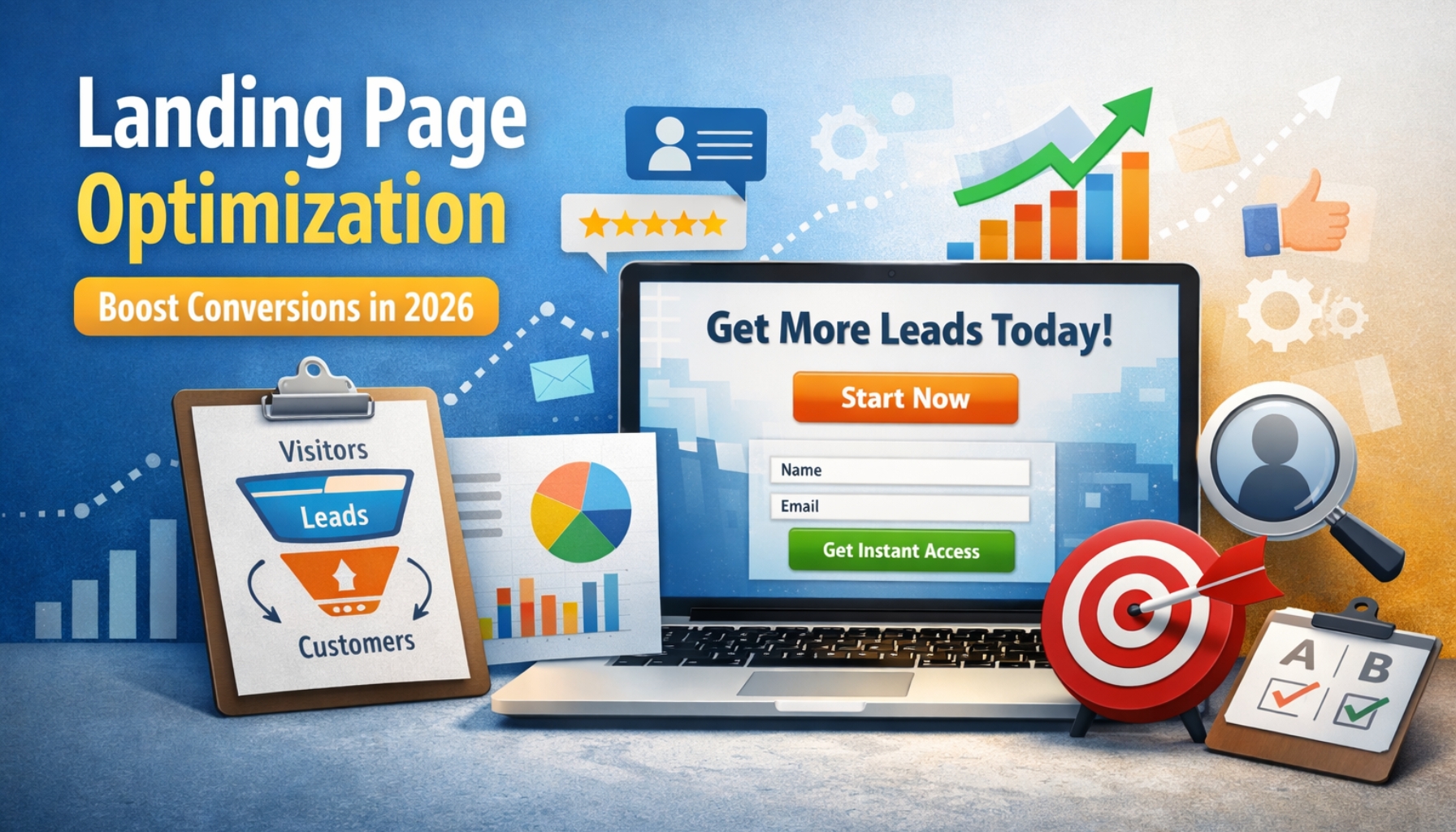
Getting traffic to your website feels great. You see visitors coming in, clicks increasing, and numbers going up. But there’s one question that really matters:
Are those visitors actually converting?
If not, then the issue isn’t your traffic, it’s your landing page.
This is where landing page optimization makes a real difference. Instead of spending more money to bring in new visitors, you focus on converting the ones you already have.
In this guide, you’ll learn practical and easy-to-apply strategies to improve your landing page and turn more visitors into leads and customers.
What is Landing Page Optimization?
Landing page optimization is the process of improving different elements of your page so that more visitors take action.
That action could be:
* Filling out a form
* Booking a call
* Signing up for a service
* Making a purchase
It’s not about guessing what works. It’s about understanding how users behave and improving their experience step by step.
Think of it as refining your page over time so it performs better with every change.
Why Landing Page Optimization Matters
Many businesses focus only on getting traffic, but traffic alone doesn’t grow a business.
What matters is how many of those visitors actually convert.
Here’s why optimization is important:
* You get better results without increasing your ad spend
* You improve the quality of your leads
* You create a smoother experience for your visitors
* You build a system that can scale over time
Even a small improvement in conversion rate can have a big impact on your results.
10 Proven Landing Page Optimization Tips
1. Write a Clear and Strong Headline
Your headline is the first thing people notice, and it plays a major role in whether they stay on your page or leave.
A good headline should clearly explain what you offer and why it matters.
Instead of being vague, focus on the outcome or benefit your visitor will get.
For example, a headline that promises a clear result will always perform better than something generic.
2. Focus on One Goal Only
Trying to achieve multiple goals on a single page often leads to confusion.
When visitors don’t know what to do next, they usually do nothing.
Keep your landing page focused on one clear objective and guide users toward that action.
A simple, focused page is much more effective than one filled with too many options.
3. Use a Strong Call-to-Action
Your call-to-action is where the conversion happens, so it needs to be clear and compelling.
Instead of using generic words, make your CTA specific and benefit-driven.
Let users know exactly what they will get when they click.
A well-written CTA removes hesitation and encourages action.
4. Improve Page Loading Speed
Page speed has a direct impact on user behavior.
If your page takes too long to load, visitors are likely to leave before they even see your content.
To improve speed, reduce heavy elements, optimize images, and keep your design efficient.
A faster page creates a better experience and increases the chances of conversion.
5. Add Social Proof
People feel more confident when they see that others have already trusted your product or service.
This is where social proof becomes important.
You can include testimonials, reviews, or real results from clients to build credibility.
When visitors see proof, they are more likely to take the next step.
6. Keep the Design Clean and Simple
A cluttered page makes it harder for users to focus.
A clean and simple design helps guide attention toward the most important elements, such as your message and your call-to-action.
Use spacing, clear sections, and a logical layout to improve readability.
Simple designs often perform better because they reduce distractions.
7. Optimize for Mobile Users
A large portion of users will visit your page from their phones.
If your landing page is not optimized for mobile devices, you risk losing a significant number of potential customers.
Make sure your content is easy to read, your buttons are easy to click, and your layout adjusts properly on smaller screens.
8.Use Visuals That Support Your Message
Images and videos should help explain your offer, not just decorate the page.
Choose visuals that are relevant and meaningful.
They should make your message clearer and help visitors understand what you are offering.
Avoid using visuals that do not add any value to the user experience.
9. Test Different Variations
What works best is not always obvious, which is why testing is important.
Try different versions of your headlines, CTAs, and layouts to see what performs better.
Even small changes can lead to noticeable improvements in conversion rates.
Optimization is an ongoing process, not something you do once and forget.
10. Use a High-Converting Funnel Setup
A landing page works best when it is part of a larger system.
Instead of just collecting leads, you should have a process in place to follow up and guide users further.
If you want a complete setup that handles everything from lead capture to follow-up, you can explore our funnel-building service here:
This approach helps turn your landing page into a consistent lead generation system.
Common Landing Page Mistakes to Avoid
Some common issues can reduce your conversion rate without you realizing it:
* Too much information without clear structure
* Weak or unclear messaging
* Lack of trust-building elements
* Slow page speed
* Poor mobile experience
Identifying and fixing these problems can quickly improve your results.
Final Thoughts
Landing page optimization is not about making your page look more attractive. It’s about making it more effective.
Start with the basics, keep your message clear, and focus on guiding users toward one action.
As you continue to test and improve, your results will grow over time.
Now it’s your turn to apply these ideas and improve your landing page performance.