
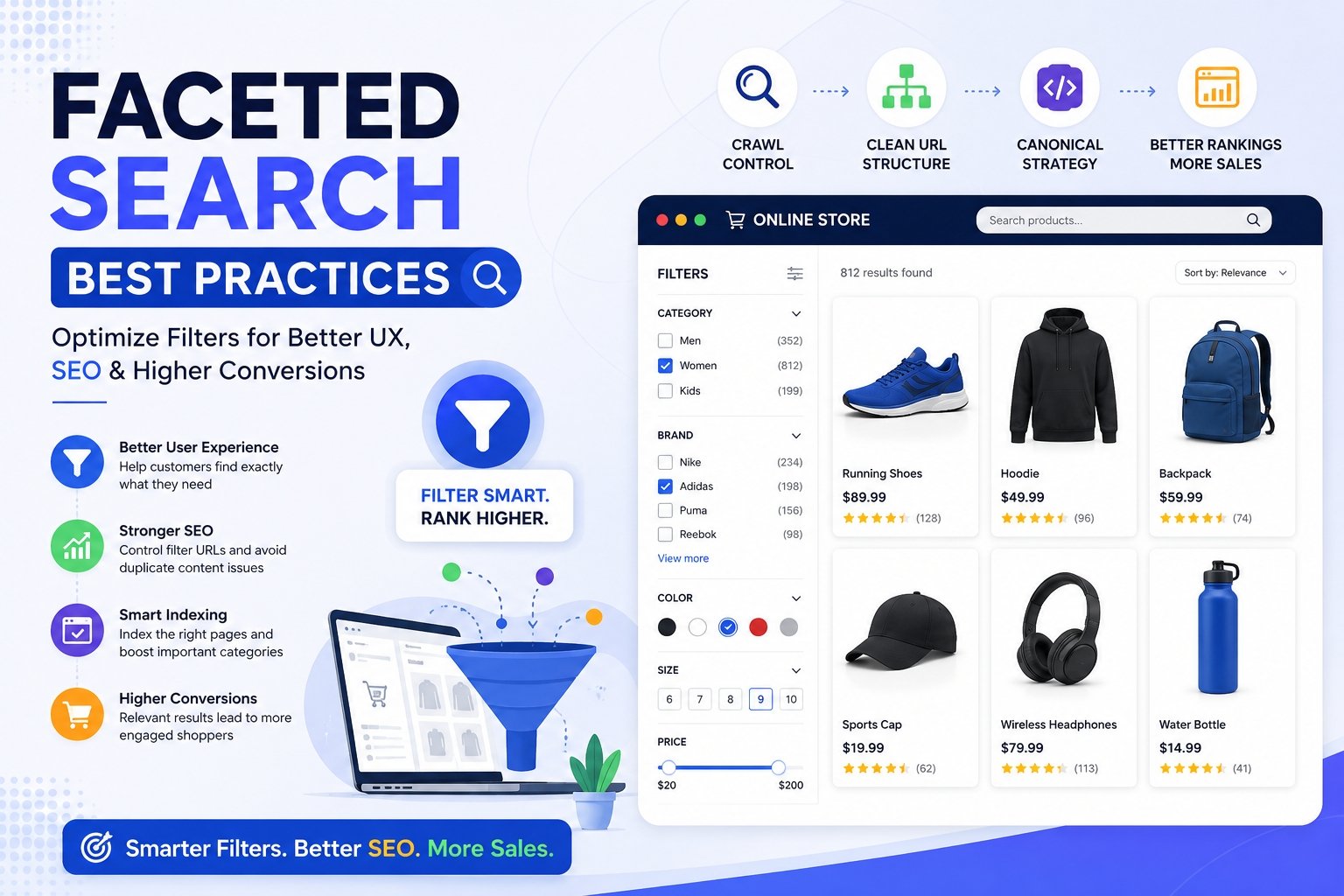
Faceted search best practices are important for any ecommerce website with a large product catalog. Filters make it easier for shoppers to find exactly what they need by narrowing products based on attributes such as price, brand, size, color, material, rating, or category.
For users, this is extremely helpful. But for SEO, faceted navigation can become complicated.
Every filter or combination of filters can potentially create a different URL. A store selling thousands of products could therefore generate hundreds, thousands, or even millions of URL combinations. Search engines may encounter these URLs while crawling the website, even when many of them provide little unique search value.
The goal isn’t to remove useful filters. Instead, the goal is to create a filtering system that provides an excellent user experience without creating unnecessary SEO problems.
What Is Faceted Search?
Faceted search is a website search and filtering system that allows users to narrow a large collection of products using multiple attributes.
For example, imagine an online shoe store.
A customer could select:
- Category: Running Shoes
- Brand: Nike
- Color: Black
- Size: 10
- Price: Under $100
The website then displays products that match those selections.
Each characteristic, such as brand, color, size, or price, is called a facet.
In simple terms:
Faceted search helps users find the right product by applying multiple filters to a product catalog.
This is especially useful for ecommerce websites where customers may have hundreds or thousands of products to choose from.
How Does Faceted Search Affect SEO?
Faceted search itself isn’t bad for SEO.
The problem starts when every filter combination creates a crawlable URL that search engines don’t need to index.
For example:
/shoes
/shoes?color=black
/shoes?size=10
/shoes?brand=nike
/shoes?color=black&size=10
/shoes?brand=nike&color=black&size=10
A website can quickly create a huge number of combinations.
Some combinations may be useful landing pages with unique search demand. Others may contain almost the same products and content as existing pages.
Google’s documentation recognizes filtering and sorting functions as one source of URL variants and explains that duplicate or highly similar URLs can be grouped during canonicalization.
That’s why ecommerce websites need a deliberate faceted search SEO strategy.
1. Decide Which Filter Pages Deserve to Be Indexed
Not every filter combination should become a Google search result.
Ask:
Does this filtered page provide unique value to someone searching on Google?
For example:
/shoes?color=black&size=10&brand=nike
may have very little standalone search value.
But a page targeting:
/running-shoes/nike
could potentially be a useful category or landing page if it has substantial product inventory and unique content.
Before allowing filter URLs to be indexed, consider:
- Search demand
- Product availability
- Uniqueness
- Content quality
- Business value
- Long-term maintenance
The objective is to make important pages discoverable while keeping unnecessary URL combinations under control.
2. Don’t Create Indexable Pages for Every Combination
This is one of the most important faceted search best practices.
Suppose your store has:
10 brands × 8 colors × 6 sizes × 5 price ranges
That’s already 2,400 possible combinations before adding other filters.
If your website creates a unique crawlable URL for every combination, the number can grow rapidly.
Instead, identify the combinations that genuinely deserve to exist as search-friendly landing pages.
For example:
Good candidate:
/mens-running-shoes/nike
Potentially low-value combination:
/mens-running-shoes?brand=nike&color=black&size=10&price=50-75
The second URL may be useful to a shopper but doesn’t necessarily need to become a permanent SEO landing page.
3. Use Canonicalization Carefully
Canonical tags can help communicate which URL should be treated as the preferred version when similar pages exist.
For example, you might have:
/shoes
/shoes?sort=price-low
If the second page doesn’t provide unique content, the main category page may be the preferred canonical URL.
However, a canonical tag isn’t a magic instruction that forces Google to select your preferred URL. Google describes canonicalization as a signal or hint, and it may choose a different canonical URL when its systems determine another URL is more representative.
So don’t rely on canonicals alone.
Your URL structure, internal links, sitemap, page content, and crawling strategy should all support the same SEO architecture.
4. Control Crawling of Unnecessary Filter URLs
Large ecommerce websites should pay attention to how search engine crawlers discover faceted URLs.
Imagine a crawler follows:
Black → Nike → Size 10 → Under $100 → Running → Men’s
and then discovers another combination.
The crawler can continue discovering combinations that provide little additional search value.
Google has official documentation specifically addressing the management of faceted navigation URLs because of this crawling challenge.
The solution depends on your website architecture.
Possible approaches include:
- Preventing unnecessary URL generation
- Controlling which filter combinations can be crawled
- Using appropriate canonicalization
- Avoiding unnecessary internal links to low-value combinations
- Keeping important category pages easily discoverable
Don’t blindly block everything, though. Some filtered pages may have legitimate search value.
5. Create SEO-Friendly Category Pages
One of the best ways to avoid depending on endless filter combinations is to create useful category and subcategory pages.
For example:
Instead of relying entirely on:
/shoes?brand=nike&gender=women&type=running
you could create:
/womens-running-shoes/nike
That page can have:
- A descriptive title
- Unique introduction
- Product listings
- Helpful FAQs
- Internal links
- Relevant product information
- Optimized metadata
This gives search engines a clearer page to understand and gives users a better landing experience.
6. Keep Your Internal Linking Under Control
Internal links are one of the ways search engines discover URLs.
If your website links to thousands of low-value filter combinations throughout navigation, search engines may discover many unnecessary URLs.
Instead, prioritize links to:
- Main categories
- Important subcategories
- Valuable product collections
- High-performing landing pages
- Pages with genuine search demand
Your internal linking structure should communicate:
These are the pages that matter most.
7. Don’t Use Thin Filter Pages as SEO Landing Pages
Creating a URL doesn’t automatically make it a useful SEO page.
Imagine a filtered page contains only three products and has almost no unique content.
If someone searches for that specific combination, the page may provide a poor experience.
Before making a filter page indexable, ask:
Does this page satisfy a real search intent?
If the answer is no, there may be little reason to make it a search landing page.
8. Make Filters Easy to Use for Customers
SEO shouldn’t come at the expense of UX.
Your filters should be:
- Easy to understand
- Fast to use
- Mobile-friendly
- Clearly labeled
- Easy to reset
- Logically grouped
For example:
Size
☐ Small
☐ Medium
☐ Large
☐ XL
Color
☐ Black
☐ White
☐ Blue
Price
☐ Under $50
☐ $50–$100
☐ $100–$200
The purpose of faceted search is to reduce the amount of work customers need to do.
A complicated filter system can increase frustration and reduce conversions.
9. Connect Faceted Search With CRO
This is where faceted search and CRO meet.
Suppose a customer arrives on a category page containing 500 products.
Without filters, they may leave because finding the right product takes too long.
With effective filters, they can quickly narrow the selection to 10 relevant products.
That can improve the shopping experience.
But don’t add dozens of filters just because you can.
Prioritize the attributes customers actually use.
For example, for clothing:
Size + Color + Brand + Price
may be much more useful than ten rarely used filters.
The best filtering system balances:
SEO + UX + conversion potential.
Common Faceted Search SEO Mistakes
Avoid these common problems:
- Creating unlimited crawlable URLs
Every filter combination doesn’t need to become an SEO page.
- Indexing low-value combinations
A filter page should have a genuine reason to appear in search.
- Using canonical tags as the only solution
Canonicalization should be part of a broader URL and crawling strategy.
- Blocking everything with robots.txt
Some valuable pages may need to remain discoverable.
- Ignoring mobile UX
Filters that work well on desktop can become frustrating on mobile.
- Creating thin category pages
A URL with a few products and no useful context isn’t automatically valuable.
- Forgetting internal links
Important category pages should be easy for both users and crawlers to discover.
Faceted Search SEO Checklist
Before launching or auditing your ecommerce filters, check:
- Are your filters useful to customers?
- Do filters generate unnecessary URL combinations?
- Which filtered pages actually have search demand?
- Are valuable filter pages indexable?
- Are low-value combinations controlled?
- Are canonical signals implemented appropriately?
- Are unnecessary URLs receiving excessive internal links?
- Are important category pages clearly linked?
- Are filter pages thin or substantially useful?
- Does the filtering experience work well on mobile?
- Are filters helping customers reach products faster?
- Are you monitoring crawl and indexing behavior?
Final Thoughts
Faceted search best practices aren’t about removing filters from an ecommerce website.
They’re about using filters intelligently.
Customers need filters because large product catalogs can be overwhelming. Search engines, however, don’t necessarily need every possible combination of those filters to become a separate searchable page.
The ideal approach is to create a clear separation between:
Pages designed for shoppers
and
Pages worth targeting through search.
Focus your SEO efforts on valuable categories, useful landing pages, strong product information, and filtered pages that genuinely satisfy search intent.
At the same time, control unnecessary URL combinations, keep your internal linking focused, and use canonicalization and crawling controls appropriately.
In other words:
Make faceted search easy for people, but make your ecommerce site easy for search engines to understand.
That balance is the foundation of effective faceted search SEO.
Frequently Asked Questions
Is faceted search bad for SEO?
No. Faceted search is useful for ecommerce UX. The SEO problem occurs when filtering creates large numbers of unnecessary URLs that search engines can crawl or index.
What is faceted search SEO?
Faceted search SEO is the process of managing ecommerce filters and their URLs so users can easily navigate products while search engines can efficiently crawl and understand the site’s valuable pages.
Should all faceted URLs be indexed?
No. Only filter combinations that provide meaningful, unique value and satisfy genuine search intent should generally be considered for indexing.
Do canonical tags fix faceted navigation problems?
Not always. Canonicalization can help Google understand preferred URLs, but it should be combined with an overall URL, internal linking, and crawling strategy.
Can faceted search improve conversions?
Yes. Effective filters can help customers find relevant products faster, reducing the amount of browsing required and potentially improving the shopping experience.
Is faceted search important for Shopify stores?
It can be especially useful for Shopify stores with large product catalogs. Merchants should design filters around meaningful product attributes while paying attention to the URLs and indexation behavior created by those filters.