
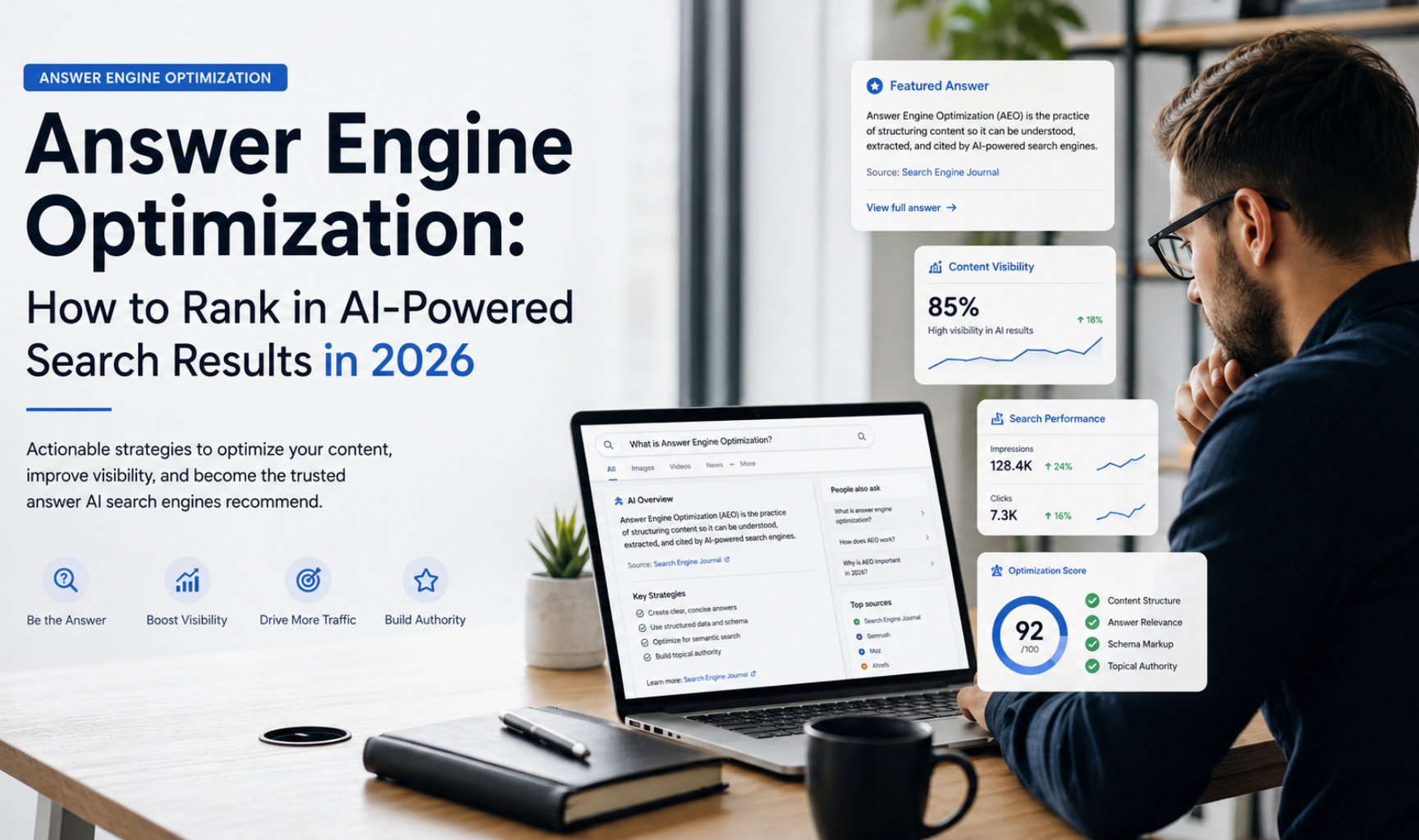
Search is changing faster than most businesses realize.
For years, the goal of SEO was straightforward: rank higher on Google, attract clicks, and drive traffic to your website. While those goals still matter, the way people search for information is evolving. Today, users are increasingly turning to AI-powered platforms like ChatGPT, Google AI Overviews, Gemini, Perplexity, and Copilot to get direct answers instead of browsing through multiple websites.
This shift has given rise to a new concept known as Answer Engine Optimization (AEO).
As AI-generated search experiences become more common, businesses that understand Answer Engine Optimization will have a significant advantage in maintaining visibility online. The future of search is not just about ranking pages anymore, it’s about becoming the source that AI trusts enough to reference.
In this guide, we’ll explore what AEO is, why it matters in 2026, and how businesses can optimize their content for AI-powered search results.
What Is Answer Engine Optimization?
Answer Engine Optimization (AEO) is the process of optimizing content so that search engines and AI-powered platforms can easily understand, extract, and present your information as a direct answer to user queries.
Traditional SEO focuses on helping web pages rank in search results. AEO focuses on helping content become the answer itself.
When someone asks:
- What is Answer Engine Optimization?
- How does AI search work?
- What is the future of SEO?
AI-powered systems analyze content across the web and generate concise responses. AEO ensures your content has a better chance of being selected as part of those responses.
In simple terms, SEO helps people find your website. AEO helps AI find your answers.
Why Answer Engine Optimization Matters in 2026
The rise of AI search has fundamentally changed user behavior.
People are no longer searching with short phrases like:
- best seo tools
- website design company
Instead, they are asking complete questions:
- What is the best way to improve website visibility in AI search?
- How can small businesses optimize for ChatGPT and Google AI Overviews?
This conversational style of searching aligns perfectly with how answer engines work.
Several trends are driving the importance of Answer Engine Optimization:
AI Overviews Are Expanding
Google increasingly provides AI-generated summaries directly within search results.
Users Want Faster Answers
People prefer instant information rather than clicking through multiple pages.
Voice Search Continues to Grow
Voice assistants rely heavily on answer-focused content.
AI Search Platforms Are Becoming Mainstream
Millions of users now use AI tools as their first source of information.
As a result, businesses must optimize not only for search rankings but also for answer visibility.
AEO vs Traditional SEO
Many marketers assume AEO is replacing SEO. The reality is that AEO builds upon traditional SEO principles.
| Traditional SEO | Answer Engine Optimization |
| Focuses on rankings | Focuses on answers |
| Targets keywords | Targets user intent |
| Optimizes pages | Optimizes information |
| Drives clicks | Builds visibility and citations |
| Search engine focused | AI and search engine focused |
The most successful websites in 2026 will combine both strategies.
Strong SEO creates discoverability. Strong AEO increases the likelihood of becoming the answer.
How AI-Powered Search Is Changing Content Strategy
One of the biggest changes in modern search is how content is evaluated.
AI systems are becoming better at understanding:
- context
- meaning
- expertise
- intent
- topical relationships
This means content can no longer rely on keyword stuffing or shallow information.
Modern AI systems reward content that demonstrates:
Clarity
Information should be easy to understand.
Structure
Well-organized headings improve comprehension.
Expertise
Content should show genuine knowledge of the subject.
Completeness
Comprehensive answers often perform better than fragmented information.
This shift encourages businesses to create content that genuinely helps users rather than simply targeting keywords.
Best Practices for Answer Engine Optimization
1. Write for Questions, Not Just Keywords
Modern users search with questions.
Instead of creating content solely around a keyword, identify the questions users are asking.
For example:
Instead of:
Answer Engine Optimization
Consider answering:
- What is Answer Engine Optimization?
- Why is AEO important?
- How does AEO differ from SEO?
- How do I optimize for AI search?
Question-based content aligns naturally with answer engines.
2. Use Clear Heading Structures
AI systems rely heavily on content structure.
Use:
- H1 for the main topic
- H2 for primary sections
- H3 for supporting information
A clear hierarchy helps both users and AI understand the flow of information.
3. Provide Direct Answers Early
One emerging AEO technique is called answer-first content.
Instead of delaying the answer, provide it immediately and then expand upon it.
For example:
What is Answer Engine Optimization?
“Answer Engine Optimization is the practice of optimizing content so AI-powered search systems can identify and present it as a direct answer.”
Then provide detailed context afterward.
This format improves answer extraction.
4. Build Topical Authority
AI platforms increasingly evaluate content within a broader topical ecosystem.
A single article is useful.
A connected library of articles is much more powerful.
For example, a website covering:
- SEO
- AEO
- GEO
- AI search
- content strategy
- structured data
signals expertise within the topic area.
Topical authority is becoming one of the strongest ranking factors in both traditional and AI-driven search.
5. Create Helpful FAQ Sections
FAQs naturally match conversational search behavior.
They also provide concise answer blocks that AI systems can easily interpret.
Examples:
What is Answer Engine Optimization?
Does AEO replace SEO?
How can businesses optimize for AI search?
These sections increase visibility opportunities.
6. Focus on Semantic Relevance
Modern AI search understands meaning rather than exact keyword repetition.
Instead of repeatedly using Answer Engine Optimization, include related concepts such as:
- AI-powered search
- AI search visibility
- search intent
- conversational search
- AI-generated answers
- search experience optimization
This improves contextual understanding.
7. Demonstrate Experience and Trust
Trust signals remain important in AI search.
Content should include:
- practical insights
- real examples
- expert observations
- accurate information
AI systems increasingly favor content that appears credible and trustworthy.
Common AEO Mistakes to Avoid
Many websites struggle because they continue using outdated SEO tactics.
Common mistakes include:
Keyword Stuffing
Overusing keywords reduces readability and weakens user experience.
Thin Content
Short, surface-level articles often fail to provide meaningful value.
Poor Structure
Large blocks of text make information difficult to understand.
Ignoring Search Intent
Users are looking for answers, not just keywords.
The goal is to satisfy curiosity, solve problems, and provide useful information.
The Future of SEO, AEO, and GEO
The future of digital visibility is likely to involve three interconnected disciplines:
SEO
Helping content rank in traditional search results.
AEO
Helping content become direct answers.
GEO (Generative Engine Optimization)
Helping AI systems understand, reference, and incorporate your content into generated responses.
Rather than competing with one another, these approaches work together.
Businesses that adopt all three strategies will be better positioned as search continues evolving.
Final Thoughts
Answer Engine Optimization is quickly becoming one of the most important aspects of digital marketing in 2026.
As AI-powered search platforms reshape how users discover information, businesses must rethink their content strategies. Ranking on search engines is still valuable, but visibility now extends beyond traditional search results.
The websites that succeed will be the ones that create clear, trustworthy, well-structured content that directly answers user questions.
By focusing on user intent, semantic relevance, topical authority, and answer-first content, businesses can improve their chances of appearing in AI-generated responses and future-proof their online presence.
The future of search isn’t just about being found. It’s about being chosen as the answer.