
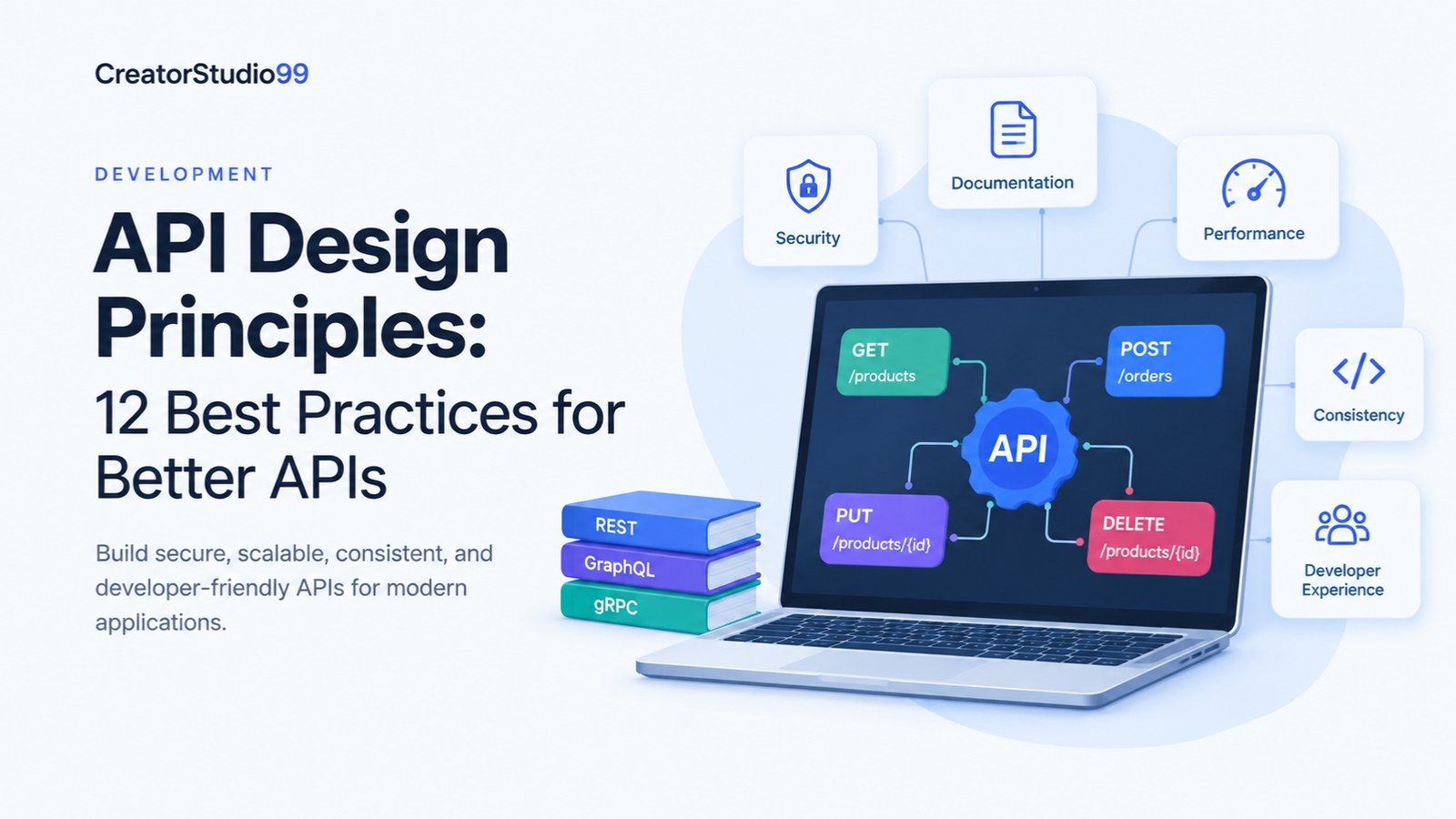
APIs power modern digital experiences. E-commerce stores connect with payment gateways, SaaS platforms exchange customer data, mobile apps communicate with servers, and businesses integrate third-party services through APIs.
But an API that works isn’t necessarily a well-designed API.
Poor naming, inconsistent responses, confusing errors, weak security, or unexpected changes can make an API difficult to integrate and expensive to maintain. Following proven API design principles helps developers create APIs that are predictable, secure, scalable, and easier to use.
Here are 12 practical API design best practices for building better APIs.
Table of Contents
What Are API Design Principles?
API design principles are guidelines that determine how applications communicate through an API.
An application programming interface (API) allows different software systems or programs to communicate with each other through a defined set of rules and interactions. In simple terms, an API acts as a bridge between software components, allowing one system to request data or functionality from another without needing to know how the other system works internally. For a broader technical overview, see Application Programming Interface on Wikipedia.
They influence decisions such as endpoint naming, HTTP methods, request and response formats, authentication, error handling, versioning, and documentation.
Think of an API as a contract between software systems. Once other applications depend on that contract, careless changes can break existing integrations.
Good API design therefore focuses not only on making an API work today, but also on keeping it understandable and maintainable as applications evolve.
Why Does Good API Design Matter?
API Design Principles improve consistency, usability, security, and long-term maintainability, helping developers build APIs that are easier to integrate and maintain as applications grow.
Consider these endpoints:
/getAllProducts
/createNewProduct
/removeProduct
Now compare them with:
GET /products
POST /products
DELETE /products/123
The second structure is more predictable. Once developers understand the pattern, they can often anticipate how other endpoints will work.
Better API design can lead to easier integrations, faster development, simpler maintenance, stronger security, and fewer problems when an application needs to scale.
1. Design for the API Consumer
APIs should be designed around what consumers need rather than simply exposing the structure of an internal database.
For example:
GET /database_customer_records
reveals implementation details that consumers don’t need.
A clearer endpoint would be:
GET /customers
Your database structure might change later, while the business concept of a customer is likely to remain.
Before creating an endpoint, ask what information or action the API consumer actually needs.
2. Use Clear Resource Names
One of the most important REST API design principles is using URLs to represent resources rather than actions.
Instead of:
GET /getProducts
POST /createProduct
DELETE /deleteProduct/123
prefer:
GET /products
POST /products
DELETE /products/123
Here, /products identifies the resource while the HTTP method describes the action.
Consistent resource naming makes an API easier to learn without requiring developers to memorize a different convention for every endpoint.
3. Use HTTP Methods Consistently
HTTP methods should communicate predictable behavior.
A typical REST API might use:
GET /products/123
POST /products
PUT /products/123
PATCH /products/123
DELETE /products/123
Generally, GET retrieves information, POST creates resources, PUT replaces or updates according to the API contract, PATCH performs partial updates, and DELETE removes resources.
Using these methods consistently makes API design principles easier for developers to understand.
4. Keep API Responses Predictable
Consistency shouldn’t stop at endpoint naming.
Requests and responses should follow predictable conventions for:
- Property names
- IDs
- Dates and times
- Pagination
- Error objects
- Null values
- Response structures
For example, if one endpoint uses product_id while another uses productId for the same naming pattern, developers have another unnecessary convention to remember.
Choose a structure and apply it consistently throughout the API.
5. Use Appropriate HTTP Status Codes
APIs should accurately communicate the result of a request.
Returning:
200 OK
“Product not found”
is confusing because the HTTP response indicates success while the message indicates failure.
Common status codes include:
200 OK — successful request
201 Created — resource successfully created
204 No Content — successful request with no response body
400 Bad Request — invalid request
401 Unauthorized — authentication required or invalid
403 Forbidden — insufficient permission
404 Not Found — resource doesn’t exist
409 Conflict — request conflicts with current state
429 Too Many Requests — rate limit reached
500 Internal Server Error — unexpected server problem
Correct status codes also make automated error handling easier.
6. Create Useful Error Responses
Knowing that something failed isn’t always enough. Developers also need to understand why.
Instead of:
{
“error”: “Invalid request”
}
return something more useful:
{
“error”: {
“code”: “PRODUCT_NOT_FOUND”,
“message”: “The requested product does not exist.”
}
}
A consistent error structure can make debugging faster and help applications respond appropriately when something goes wrong.
Avoid exposing sensitive internal information such as database queries, stack traces, or credentials in error responses.
7. Plan API Versioning and Compatibility
APIs change as products evolve.
A common versioning approach is:
/api/v1/products
But versioning shouldn’t become an excuse to create a new API version for every minor change.
Backward-compatible additions can often be introduced without breaking existing consumers. Breaking changes require more care.
Developers should establish a strategy for API versioning, backward compatibility, deprecation, and migration before major changes become necessary.
8. Build Security Into API Design
Security should be considered during API design rather than added after development.
Important considerations include:
- HTTPS
- Authentication
- Authorization
- Input validation
- Rate limiting
- Access scopes
- Sensitive-data protection
Authentication establishes who is making a request, while authorization determines what that user or application is permitted to do.
APIs should also validate incoming data and avoid returning sensitive information that consumers don’t need.
9. Use Pagination and Filtering
Returning huge datasets in a single response can hurt performance.
Imagine an ecommerce API containing hundreds of thousands of products. Instead of always returning everything from:
GET /products
support pagination:
GET /products?page=2&limit=20
You can also allow useful filtering:
GET /products?category=shoes
For very large or frequently changing datasets, cursor-based pagination may be more appropriate than page-number pagination.
The best approach depends on how consumers need to access the data.
10. Maintain Consistent API Conventions
An API becomes easier to use when developers can predict what comes next.
Avoid inconsistent patterns such as:
/products
/customer
/order_items
without a deliberate naming strategy.
Establish conventions for resource naming, URLs, dates, errors, pagination, responses, authentication, and filtering.
The goal isn’t simply visual neatness. Consistency reduces the number of rules developers must learn before they can work effectively with your API.
11. Create Useful API Documentation
Even a well-designed API becomes difficult to use when its documentation is incomplete or outdated.
API documentation should clearly explain:
- Available endpoints
- HTTP methods
- Parameters
- Authentication
- Request bodies
- Response structures
- Error responses
- Working examples
Standards such as OpenAPI can provide a machine-readable API description and support documentation, testing, code generation, and other development workflows.
Most importantly, documentation should stay synchronized with the actual API. Outdated documentation can be worse than missing documentation because developers may build integrations based on incorrect behavior.
12. Design APIs for Future Change
One of the most overlooked API design Principles is designing beyond the initial launch.
Consider an ecommerce API that initially returns:
{
“id”: 123,
“name”: “Classic Hoodie”,
“price”: 49.99
}
Later, the platform might need to support currencies, variants, inventory, discounts, subscriptions, or multiple markets.
A good API architecture should accommodate reasonable growth without forcing every existing integration to be rebuilt.
Before finalizing an API contract, ask:
What happens when 100 applications depend on this instead of five?
That question often exposes design decisions worth reconsidering before development begins.
API Design Example: Bad vs. Better
Consider this ecommerce API:
POST /createNewProduct
GET /getProduct?id=123
POST /deleteProduct?id=123
A cleaner REST-oriented structure would be:
POST /products
GET /products/123
DELETE /products/123
Then combine that structure with appropriate status codes, predictable responses, useful error messages, authentication, pagination for collections, and accurate documentation.
This illustrates the larger purpose behind API design principles: developers shouldn’t have to constantly guess how an API behaves.
How to Apply API Design Principles in a Real Project
Understanding API Design Principles is useful, but applying them to a real project is where they become valuable. Whether you are building an ecommerce platform, SaaS application, mobile app, or internal business system, good API design should start with the way developers and users will interact with the system.
Start by identifying the main resources your API needs to expose. For an ecommerce application, these could include products, customers, orders, carts, payments, and categories. Each resource should have a clear and predictable URL structure. For example, /products can represent a collection of products, while /products/123 can represent one specific product. This approach makes the API easier to understand and reduces confusion when new endpoints are added.
Next, decide how each resource should be accessed or modified. HTTP methods should communicate the intended action clearly. A GET request can retrieve information, POST can create a new resource, PUT or PATCH can update an existing resource, and DELETE can remove one. Keeping these actions consistent helps developers understand how your API works without having to study every endpoint individually.
The structure of your responses also matters. If one endpoint returns product information using fields such as product_name, price, and category, other related endpoints should follow a similar structure where possible. Consistency becomes especially important when an API contains dozens or hundreds of endpoints. Developers should not have to remember completely different response formats for similar resources.
Error handling should be planned at the same time. Instead of returning vague messages such as “Something went wrong,” provide useful information that helps developers understand what happened and what they can do next. A response could identify the type of error, explain the issue, and, when appropriate, identify the field that needs to be corrected. Consistent error responses make debugging and integration much easier.
Security should also be considered from the beginning rather than added after development is complete. APIs often provide access to sensitive information, including customer details, account information, orders, and payment-related data. Authentication, authorization, input validation, rate limiting, HTTPS, and appropriate access controls should therefore be part of the initial API architecture. An API that is easy to use but poorly secured can create serious problems for the business and its customers.
Another important consideration is versioning. APIs often continue to serve existing applications long after the original development team has moved on to other projects. If a major change is introduced without considering existing integrations, an update can unexpectedly break mobile apps, websites, partner systems, or third-party tools. Establishing a clear versioning strategy helps teams introduce improvements while maintaining compatibility with older clients.
Documentation should evolve alongside the API. Developers need to know what each endpoint does, which parameters are required, what authentication is needed, what responses look like, and what errors they may encounter. Providing realistic request and response examples can make documentation much more useful than simply listing technical definitions. Tools such as OpenAPI can also help teams describe and maintain API specifications in a structured way.
Finally, test the API from the perspective of its consumers. A technically functional endpoint may still be difficult to use if its naming, response structure, authentication process, or documentation is confusing. Ask another developer to integrate with the API without relying on internal explanations. Their questions and difficulties can reveal design problems that may not be obvious to the original development team.
The goal of applying API Design Principles is not to create the most complicated API possible. It is to create an interface that is predictable, secure, maintainable, and easy for other systems and developers to work with. When these principles are considered from the beginning, teams can reduce technical debt, simplify future development, and create APIs that remain useful as their applications evolve.
Common API Design Mistakes
Common mistakes include inconsistent endpoint naming, returning success codes for errors, exposing internal database structures, weak authentication, poor error messages, undocumented breaking changes, returning massive datasets without pagination, and letting documentation fall behind the API design principles.
Another mistake is treating every REST convention as an absolute rule. REST, GraphQL, gRPC, and RPC-style APIs solve different problems. The architecture should ultimately fit the API’s consumers, requirements, and use cases.
API Design Principles Checklist
Many API problems can be avoided by applying API Design Principles consistently throughout the development process rather than fixing design issues after the API has already been released. Before releasing an API, check that resource names are clear, HTTP methods behave consistently, status codes accurately describe outcomes, error responses are useful, authentication and authorization are properly implemented, large collections support pagination, naming conventions are consistent, breaking changes have a migration strategy, and documentation reflects the actual API.
Build APIs for Long-Term Growth
Good API Design Principles are not only about making an API work today, they also help ensure it remains reliable as your application, users, and integrations grow. A well-designed API should be easy for developers to understand, secure enough to protect data, consistent across endpoints, and flexible enough to support future changes. By treating API design as an ongoing part of product development rather than a one-time technical task, businesses can reduce maintenance issues and create a stronger foundation for scalable digital products.
Final Thoughts
Strong API design principles aren’t about making an API unnecessarily complex. They’re about making it predictable for the developers and systems that depend on it.
Start with the API consumer, keep naming and behavior consistent, return meaningful errors, consider security from the beginning, and plan for future changes.
For businesses building SaaS products, ecommerce platforms, mobile applications, or custom software integrations, thoughtful API design can mean faster integrations, easier maintenance, and fewer development problems as the product grows.
Frequently Asked Questions
What are API design principles?
API design principles are guidelines for creating APIs that are consistent, predictable, secure, scalable, maintainable, and easy for developers to integrate.
What makes a good API design?
Good API design combines clear resource naming, consistent behavior, meaningful errors, appropriate security, useful documentation, and an architecture capable of evolving without unnecessary breaking changes.
What are REST API design principles?
REST API design generally emphasizes resource-oriented URLs, standard HTTP methods, stateless communication, meaningful status codes, consistent representations, and predictable behavior.
Should API endpoints use nouns or verbs?
REST-style APIs generally use nouns to identify resources and HTTP methods to communicate actions. For example, GET /products is generally preferable to /getProducts.
Why is API versioning important?
API versioning helps teams manage breaking changes while allowing existing consumers to continue using an older API contract during migration.
What is the difference between API design and API development?
API design defines the contract, resources, endpoints, requests, responses, errors, security, and expected behavior. API development implements that contract in working software.
What are the most important API Design Principles to follow?
The most important API Design Principles include designing for the API consumer, using clear resource naming, following HTTP methods correctly, maintaining consistent responses and error handling, planning versioning, implementing strong security, providing useful documentation, and designing for scalability. Following these principles makes APIs easier to use, maintain, integrate, and adapt as applications grow.