
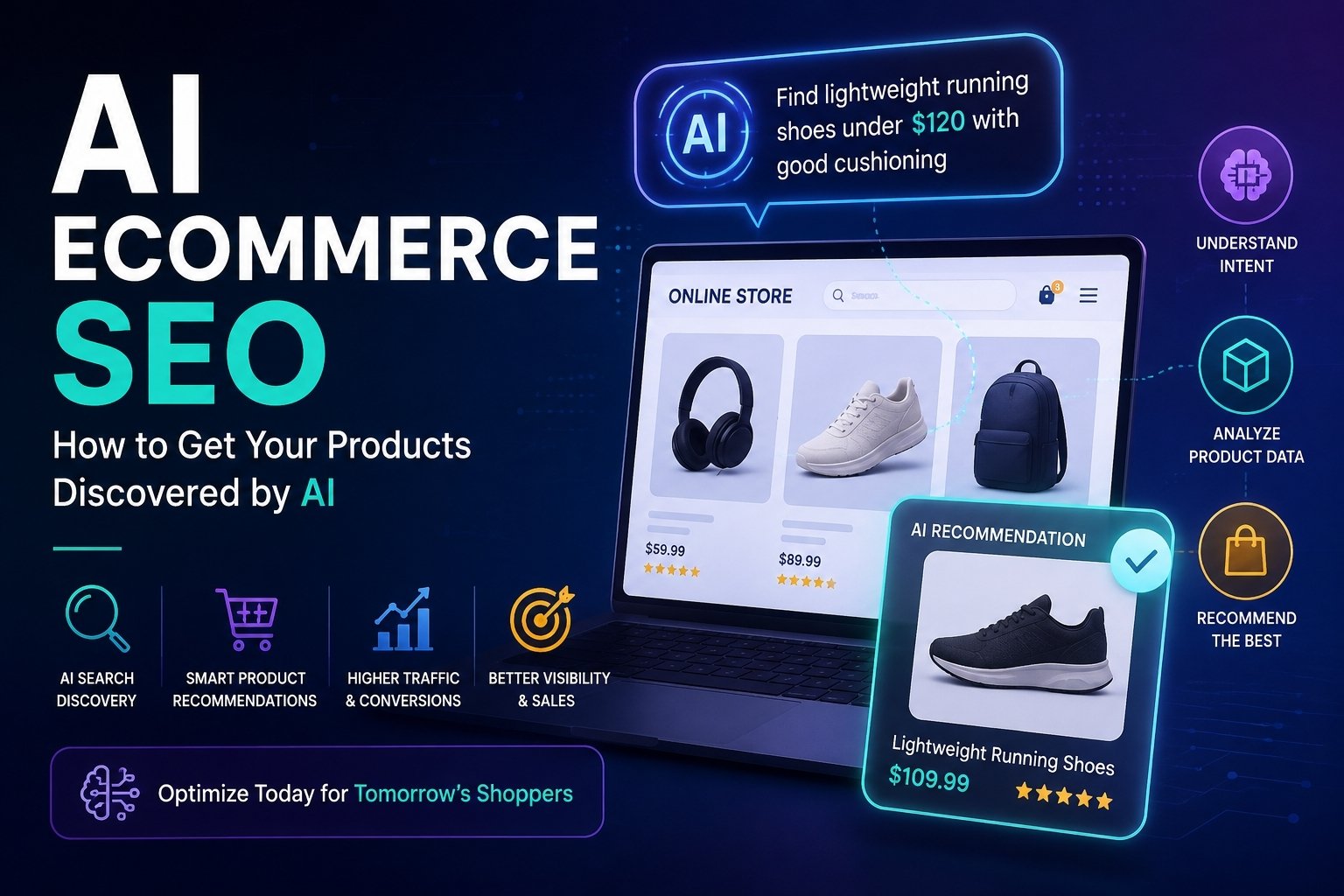
AI Ecommerce SEO is changing how online stores attract customers. Shoppers are increasingly using AI-powered search and shopping tools to discover products, compare alternatives, understand features, and decide what to buy. Instead of searching for a product, opening several websites, and comparing them manually, a customer can describe what they need and let an AI system narrow down the options.
For ecommerce brands, this creates a new opportunity and a new SEO challenge.
Traditional ecommerce SEO focuses heavily on rankings, keywords, product pages, and organic clicks. AI-driven shopping adds another layer: making your products easy for AI systems to understand, evaluate, and recommend.
The goal isn’t to replace traditional SEO. It is to make your product information useful for both search engines and AI-powered discovery systems.
What Is AI Ecommerce SEO?
AI Ecommerce SEO is the process of optimizing an online store, product information, and brand presence so AI-powered search and shopping systems can understand, discover, and potentially recommend its products.
Traditional ecommerce SEO might target a search such as:
“Best running shoes”
AI-powered shopping can handle a much more detailed request:
“Find lightweight running shoes under $120 for long-distance running with good cushioning.”
The second query contains multiple requirements, including:
- Product category
- Price
- Weight
- Use case
- Performance
- Features
- Customer preferences
This means ecommerce businesses need to provide complete, accurate, and structured product information, not simply repeat a target keyword.
Why AI Ecommerce SEO Matters in 2026
Product discovery is becoming increasingly conversational.
A shopper may no longer begin with a short keyword. Instead, they may explain exactly what they want and expect an AI system to compare products for them.
For ecommerce businesses, this creates a new discovery path:
Customer intent → AI understanding → Product evaluation → Recommendation → Product page → Purchase
Shopify has reported significant growth in AI-driven traffic and orders, while also highlighting the importance of product data in helping AI systems understand and match products to shoppers’ requirements.
This doesn’t mean Google Search has become irrelevant. Instead, ecommerce brands now need to consider both traditional search visibility and AI-driven product discovery.
Traditional Ecommerce SEO vs AI Ecommerce SEO
Traditional ecommerce SEO and AI Ecommerce SEO overlap, but their emphasis can be different.
| Traditional Ecommerce SEO | AI Ecommerce SEO |
| Keyword targeting | User intent and product attributes |
| Search rankings | Product recommendations |
| SERP visibility | AI discovery visibility |
| Product keywords | Detailed product information |
| Organic CTR | Discovery, engagement and conversion |
| Backlinks | Brand/entity credibility |
| Product page optimization | Product data + page optimization |
The important takeaway is that AI Ecommerce SEO doesn’t replace ecommerce SEO fundamentals.
It builds on them.
1. Create Detailed Product Information
One of the most important steps in AI Ecommerce SEO is making your product information comprehensive.
Consider a product page that says:
“Premium cotton hoodie.”
That description gives very little useful information.
Now compare it with:
- Material: 100% organic cotton
- Weight: 320 GSM
- Fit: Oversized
- Sizes: S–XXL
- Available colors: Black, white and grey
- Suitable for: Streetwear and casual wear
- Care instructions: Machine washable
- Manufacturing location: Clearly stated
- Shipping information: Clearly stated
The second version gives both customers and machines significantly more context.
AI systems can use product attributes to better understand whether a product matches a specific request.
2. Optimize Product Titles and Descriptions
Your product title should clearly communicate what the product is.
Avoid titles that rely on vague marketing language.
Instead of:
“The Ultimate Everyday Essential”
consider:
“Men’s Oversized Organic Cotton Hoodie – Black, 320 GSM”
The second title communicates:
- Audience
- Product type
- Material
- Style
- Color
- Product specification
Your description should then expand on these details naturally.
Don’t write descriptions purely for algorithms.
Write them for the customer first, while ensuring that important product attributes are clearly available.
3. Use Structured Product Data
Structured data can help search engines understand important information about your products.
For ecommerce websites, product-related structured data can communicate information such as:
- Product name
- Brand
- Image
- Description
- Price
- Availability
- Reviews
- Ratings
- SKU
Google recommends using appropriate structured data to help it understand ecommerce pages and product information.
However, structured data shouldn’t be treated as a shortcut to AI visibility.
Your visible product information should accurately match the structured data.
Don’t mark up information that isn’t actually present on the page.
4. Build Strong Product Entities
AI systems need to understand more than individual keywords.
They need context.
For example:
Nike
→ Running shoes
→ Air Zoom series
→ Running
→ Cushioning
→ Specific models
→ Reviews
→ Retailers
This is an example of an entity relationship.
For an ecommerce brand, make sure your website clearly communicates:
- Who your brand is
- What products you sell
- Which categories you operate in
- What makes your products different
- Who your products are designed for
Consistent information across your website and reputable external sources can strengthen your overall entity understanding.
5. Make Your Product Pages Answer Real Questions
AI-powered shopping is often conversational.
Customers may ask:
“Is this jacket suitable for winter?”
“Does this laptop have enough RAM for video editing?”
“Which size should I choose?”
“Is this product waterproof?”
Your product page should anticipate these questions.
Adding a useful FAQ section can make product pages more informative while reducing friction during the buying process.
Instead of simply writing:
“Water-resistant jacket.”
Explain:
“The outer shell is water-resistant and designed to handle light rain. It is not intended for prolonged heavy rainfall.”
That’s clearer, more trustworthy, and more useful.
6. Don’t Ignore Reviews and Reputation
Product recommendations aren’t based only on your own description.
Reviews and third-party discussions can provide additional information about how customers perceive your products.
Encourage genuine customers to leave detailed reviews.
Useful reviews can mention:
- Product quality
- Fit
- Durability
- Actual use cases
- Pros and cons
- Size accuracy
- Performance
This creates additional first-hand information around your products.
However, don’t manufacture reviews or manipulate customer feedback.
Authentic customer experiences are far more valuable than artificial signals.
7. Optimize for Conversational Search Intent
Keyword research should evolve alongside AI search.
Instead of targeting only:
“best Shopify theme”
consider the questions customers might actually ask:
“What’s the best Shopify theme for a small fashion brand?”
“Which Shopify theme is fastest for an ecommerce store?”
“What Shopify theme works best for a clothing store with hundreds of products?”
These longer questions reveal intent.
Your content strategy should therefore cover:
Keyword → Question → Intent → Product attributes → Solution
This helps you create content that is useful beyond a single search phrase.
8. Connect AI SEO With CRO
Getting discovered by AI is only the first step.
Imagine an AI platform sends a shopper directly to your product page.
What happens next?
If the page has:
- Poor mobile UX
- Slow loading
- Unclear pricing
- Weak product images
- Complicated variants
- Missing reviews
- Confusing shipping information
- No clear call to action
the AI referral may not produce a sale.
That’s why AI Ecommerce SEO and CRO should work together.
Think of the complete funnel:
AI discovery
↓
Product recommendation
↓
Website visit
↓
Product-page experience
↓
Add to cart
↓
Checkout
↓
Purchase
SEO creates discovery.
CRO helps turn that discovery into revenue.
9. Create Original Information
One of the biggest mistakes ecommerce brands can make is publishing the same generic product descriptions as everyone else.
If ten stores describe a product in almost identical language, there is little information gain.
Try adding original information such as:
- Original product testing
- Comparison charts
- Real customer use cases
- First-hand product photography
- Demonstration videos
- Size comparisons
- Expert recommendations
- Detailed buying guides
- Original product comparisons
For example, instead of saying:
“This laptop is good for creators.”
you could explain:
“We tested the laptop with common video-editing workflows and found that its 32GB RAM configuration handled multiple high-resolution timeline layers more comfortably than the 16GB version.”
That’s much more useful.
AI Ecommerce SEO Checklist
Before publishing or optimizing an ecommerce page, ask:
- Is the product clearly identified?
- Are important product attributes available?
- Is the title descriptive?
- Is the product description genuinely useful?
- Are price and availability accurate?
- Is appropriate product structured data implemented?
- Are reviews authentic and visible?
- Does the page answer common customer questions?
- Is the brand entity clearly defined?
- Is the content original?
- Is the page mobile-friendly?
- Is the checkout journey simple?
- Are important product pages internally linked?
- Can customers easily understand why the product is different?
Final Thoughts
AI Ecommerce SEO is changing the way online stores should think about product discovery.
The objective isn’t simply to rank for a product keyword.
It’s to make your product, brand, attributes, expertise, reputation, and customer experience easy to understand across modern discovery systems.
The most effective approach combines traditional ecommerce SEO with:
Clear product data + search intent + structured information + entity optimization + original content + genuine reviews + CRO.
Think beyond:
“How do I rank this product?”
Start asking:
“If an AI system had to recommend this product to the perfect customer, would it have enough accurate information to understand why it should choose us?”
That’s the mindset behind modern AI Ecommerce SEO.
And as AI-driven shopping continues to evolve, ecommerce brands that invest in high-quality product information, strong brand entities, useful content, and frictionless customer experiences will be better positioned to compete for the next generation of product discovery.
Frequently Asked Question
What is AI Ecommerce SEO?
AI Ecommerce SEO is the process of optimizing ecommerce websites and product information so AI-powered search and shopping systems can better understand, discover, evaluate, and potentially recommend products.
Is AI Ecommerce SEO replacing traditional ecommerce SEO?
No. Traditional SEO remains important. AI Ecommerce SEO adds another layer focused on conversational discovery, product understanding, entities, structured information, and AI-driven recommendations.
How can I optimize my product pages for AI search?
Start with complete product information, descriptive titles, detailed specifications, accurate structured data, genuine reviews, useful FAQs, and original content that answers customer questions.
Does product schema help with AI Ecommerce SEO?
Structured data can help search engines understand product information. However, it should complement high-quality visible content rather than being treated as a guarantee of AI recommendations.
Are product reviews important for AI product discovery?
Genuine reviews can provide additional information about product quality, customer experiences, use cases, and limitations. They can contribute to the broader information available about a product and brand.
Should Shopify stores focus on AI Ecommerce SEO?
Yes. Shopify merchants can benefit from making their product catalogs clear, complete, structured, and easy for both customers and search systems to understand. AI-driven product discovery makes strong product data increasingly valuable.