
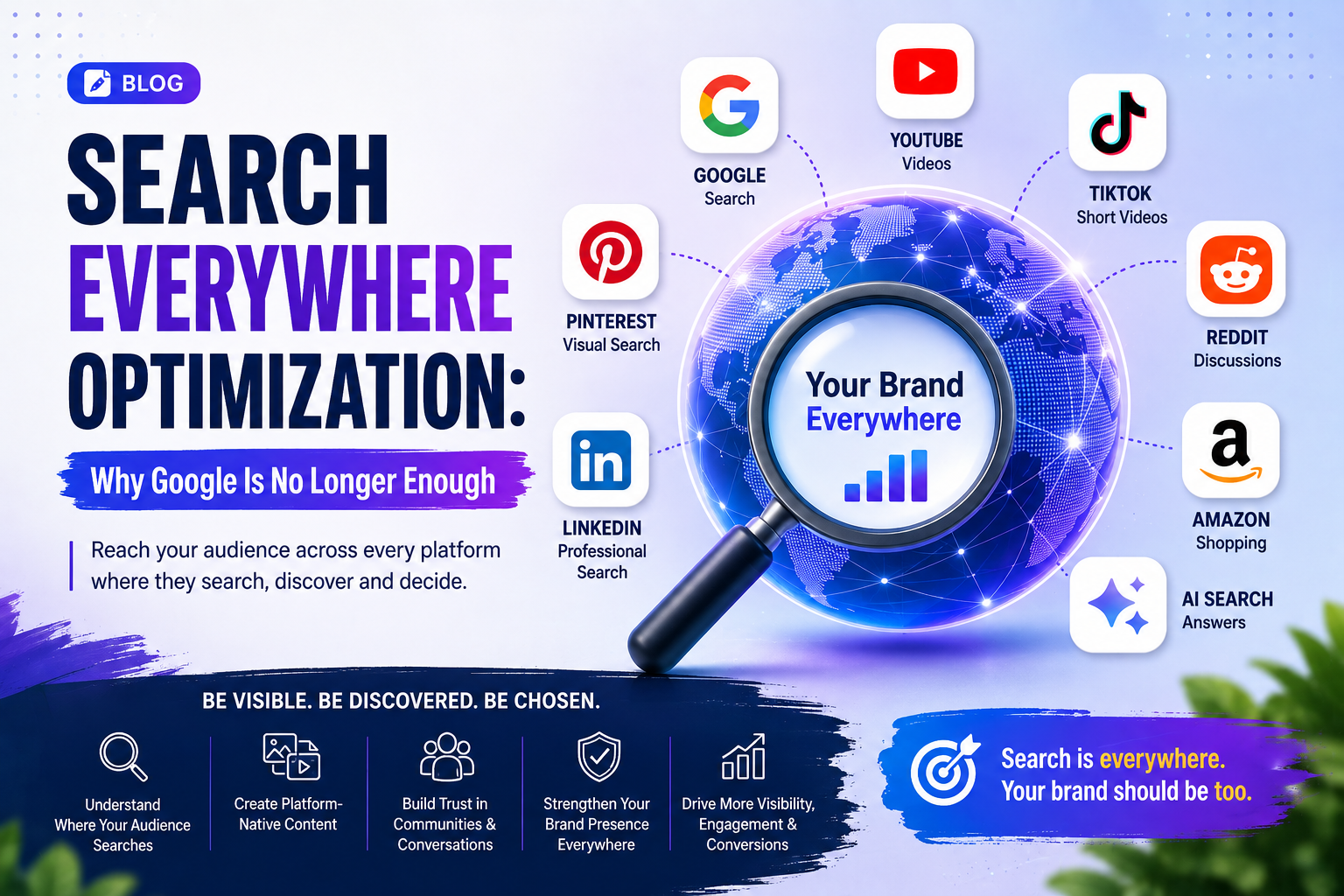
For years, SEO had a simple goal: get your website to rank higher on Google and earn organic traffic. But search behavior has changed. People now discover products on TikTok, watch tutorials on YouTube, ask Reddit communities for recommendations, research products on Amazon, and use AI assistants for comparisons and answers. Search is no longer limited to a traditional search engine.
This shift has created a broader approach known as Search Everywhere Optimization.
Search Everywhere Optimization focuses on making a brand discoverable wherever its audience searches, researches, compares, and makes decisions. It does not mean abandoning Google or traditional SEO. Instead, it expands the definition of search visibility to include the platforms and experiences people already use.
The question is no longer only, “How do I rank on Google?”
It is becoming:
“Where does my audience search, and how can my brand become visible there?”
What Is Search Everywhere Optimization?
Search Everywhere Optimization is the process of improving a brand’s visibility across the different platforms and search experiences where its audience discovers information.
Traditional SEO mainly focuses on search engines such as Google and Bing. Search Everywhere Optimization takes a broader approach by considering platforms such as:
- YouTube
- TikTok
- Amazon
- AI assistants and generative search
- Industry directories and review platforms
- Other platform-specific search systems
The exact platforms depend on the audience and industry.
For example, someone looking for a Shopify tutorial might search Google or YouTube. Someone looking for honest opinions about a product might search Reddit. Someone comparing products might use Amazon. Another user may ask an AI assistant to summarize the best options.
The goal is therefore not to publish the same content everywhere.
The goal is to understand where your audience searches and build relevant visibility on those surfaces.
Why Is Search Everywhere Optimization Becoming Important?
Search behavior has become increasingly fragmented.
Semrush’s 2026 research describes audiences spending significant time across multiple search and discovery platforms, with YouTube, TikTok, Amazon, Reddit, and other surfaces playing roles beyond traditional Google search.
At the same time, AI has introduced another layer to the discovery journey. AI search experiences can synthesize information from multiple sources, meaning a user may receive an answer or recommendation without following the traditional path of clicking through several Google results. Semrush distinguishes traditional search visibility from AI visibility, where brands may be mentioned or cited in AI-generated answers.
This creates a major strategic change.
Your customer may discover your brand before they ever visit your website.
They may see:
Your YouTube video → your Reddit discussion → your website → an AI recommendation → your product page
The discovery journey can happen across multiple platforms.
Search Everywhere Optimization vs Traditional SEO
Traditional SEO asks:
“How can we improve our visibility in search engine results?”
Search Everywhere Optimization asks:
“How can we improve our visibility throughout the entire discovery journey?”
Traditional SEO remains extremely important because Google and other search engines continue to drive significant discovery.
But Search Everywhere Optimization recognizes that search intent can exist outside traditional search engines.
For example:
| Traditional SEO | Search Everywhere Optimization |
| Google rankings | Google + multiple platforms |
| Website traffic | Overall brand visibility |
| Keywords | Search behavior and intent |
| Web pages | Web + video + communities + marketplaces |
| Backlinks | Broader authority and mentions |
| SERP visibility | Discovery-to-decision visibility |
| Organic clicks | Visibility, engagement, conversions and mentions |
This doesn’t mean SEO is dead.
It means SEO is becoming one component of a larger search strategy.
Where Should You Optimize?
You don’t need to be everywhere.
This is one of the biggest misunderstandings about Search Everywhere Optimization.
If your audience doesn’t use TikTok to research your product, spending hours creating TikTok content may produce little value.
Instead, identify the platforms that influence your audience’s decisions.
Continue investing in technical SEO, content quality, internal linking, entities, structured data, authority, and search intent.
Google remains an important part of the overall ecosystem.
YouTube
YouTube is valuable for tutorials, product demonstrations, reviews, comparisons, educational content, and visual explanations.
A written article explaining “how to use Shopify” can become a video demonstrating the process.
Reddit can be valuable when users are looking for opinions, experiences, recommendations, and community discussions.
The important word is helpfulness.
Creating promotional comments simply to insert links is not a Search Everywhere strategy.
Participating genuinely in relevant discussions is much more sustainable.
TikTok
TikTok can be particularly useful for discovery-oriented content, short tutorials, product demonstrations, trends, and visually engaging explanations.
The content needs to match the platform rather than simply being a shortened version of a blog.
Pinterest can be powerful for visual discovery, especially for niches involving design, ecommerce, fashion, templates, recipes, events, home inspiration, and other visually driven topics.
Amazon and Marketplaces
For ecommerce brands, marketplace visibility can directly influence product discovery and purchase decisions.
Product titles, descriptions, images, reviews, categories, and other marketplace signals all contribute to discoverability.
AI Search
AI platforms introduce another discovery environment.
Your brand can be encountered when users ask AI systems questions such as:
“What are the best Shopify agencies for a small business?”
This makes brand clarity, authoritative content, consistent information, and third-party visibility increasingly important considerations.
How to Build a Search Everywhere Optimization Strategy
A successful strategy doesn’t begin by opening ten social media accounts.
It begins with search intent.
Step 1: Identify your most important topics
Start with the topics that actually matter to your business.
For example, a Shopify-focused business might i
dentify:
- Shopify themes
- Shopify store development
- Shopify SEO
- Shopify experts
- Ecommerce website design
Don’t start with hundreds of keywords.
Start with the topics that can influence customers.
Step 2: Find where people search for those topics
Take one topic and search for it across different platforms.
For example:
“Best Shopify themes”
Check:
- YouTube
- TikTok
- AI search
- Amazon, if relevant
You may discover that different platforms satisfy different parts of the same search journey.
Step 3: Study what already wins
Don’t assume every platform works like Google.
Look at:
- Which videos appear?
- Which Reddit discussions receive engagement?
- Which brands are repeatedly mentioned?
- Which articles are cited?
- Which products appear?
- What questions do users repeatedly ask?
This reveals the platform-specific search intent.
Step 4: Create platform-native content
This is where many businesses make a mistake.
They write one blog post and copy it everywhere.
Instead, transform the same underlying expertise into different formats.
For example:
Blog:
“10 Best Shopify Themes for Fashion Stores”
YouTube:
“10 Shopify Themes for Fashion Stores Compared”
TikTok:
“3 Shopify Theme Mistakes Fashion Brands Make”
Pinterest:
Visual comparison of Shopify theme layouts
Reddit:
A useful discussion explaining what to consider when choosing a Shopify theme
AI-search-ready website content:
Clear comparisons, definitions, examples, and supporting evidence
The topic remains connected, but the format matches the platform.
The Role of AEO and GEO in Search Everywhere Optimization
This is where Search Everywhere Optimization connects directly with the AEO and GEO concepts we’ve already discussed.
SEO
Helps your website become visible in traditional search.
AEO
Focuses on providing useful answers to questions.
GEO
Focuses on visibility within generative AI experiences.
Search Everywhere Optimization
Connects these approaches with the wider discovery ecosystem.
Think of it as:
SEO → Search engines
AEO → Answers
GEO → Generative AI
Search Everywhere Optimization → The entire discovery ecosystem
These aren’t necessarily competing strategies.
They can work together.
Why Entity SEO Matters for Search Everywhere Optimization
One of the strongest foundations of Search Everywhere Optimization is entity consistency.
Imagine your website says:
“CreatorStudio99 provides Shopify themes.”
Your LinkedIn profile says:
“CreatorStudio99 is a digital marketing agency.”
A directory says:
“CreatorStudio99 provides WordPress services.”
Another platform says:
“CreatorStudio99 sells digital planners.”
Different services aren’t necessarily a problem, but unclear or inconsistent positioning can make it harder for users and systems to understand what the brand actually represents.
Your:
- Website
- Social profiles
- Author profiles
- Business directories
- Marketplace profiles
- External articles
- Video descriptions
should communicate a reasonably consistent identity.
This doesn’t mean copying the same description everywhere.
It means building a coherent entity.
Common Search Everywhere Optimization Mistakes
1. Trying to be everywhere
You don’t need every platform.
Choose the surfaces where your audience actually searches.
2. Copying the same content everywhere
A blog paragraph isn’t automatically good TikTok content or a good Reddit response.
Adapt the format and intent.
3. Treating social platforms only as backlink sources
Search Everywhere Optimization is about visibility and usefulness, not collecting as many profile links as possible.
4. Ignoring AI search
AI assistants and generative search are becoming another part of the discovery ecosystem. Brands should consider how clearly their expertise, products, services, and identity are represented across their digital presence.
5. Measuring only Google rankings
Google rankings still matter, but they aren’t the only possible visibility metric.
A broader strategy can track:
- Organic rankings
- Website traffic
- YouTube visibility
- Video engagement
- Brand mentions
- Reddit visibility
- AI citations or mentions
- Referral traffic
- Marketplace visibility
- Conversions
A Practical Search Everywhere Optimization Framework
Use this simple framework:
1. Discover
Find where your audience searches.
2. Map
Connect each important topic to the platforms where it appears.
3. Create
Develop content that matches the platform and search intent.
4. Connect
Build consistent entities, topics, and brand information across platforms.
5. Measure
Track visibility and business outcomes across the ecosystem.
6. Improve
Double down on platforms that generate meaningful visibility, engagement, leads, or sales.
This prevents Search Everywhere Optimization from becoming a meaningless checklist of “post everywhere.”
Search Everywhere Optimization Checklist
Before launching your strategy, ask:
- Have we identified our highest-value topics?
- Do we know where our audience searches for those topics?
- Have we analyzed Google search results?
- Have we checked YouTube and other relevant platforms?
- Have we researched community discussions?
- Have we checked AI search visibility?
- Is our brand/entity information consistent?
- Are we creating platform-native content?
- Are we measuring more than Google rankings?
- Are we focusing on business outcomes rather than vanity metrics?
Final Thoughts
Search Everywhere Optimization doesn’t mean abandoning Google. It means understanding that Google is no longer the only place where discovery happens.
A customer might discover your brand through a Google search, watch your YouTube video, read a Reddit discussion, see your Pinterest content, compare your products on a marketplace, and finally ask an AI assistant whether you’re the right choice.
That is one customer journey, but it happens across multiple search surfaces.
The brands that understand this shift won’t simply ask:
“How do we rank #1?”
They’ll ask:
“How do we become visible, useful, trusted, and memorable wherever our audience searches?”
That is the real opportunity behind Search Everywhere Optimization.
Traditional SEO remains the foundation, but the future of search visibility is increasingly broader than a single search engine. By combining strong SEO fundamentals with platform-specific content, entity consistency, useful answers, community participation, video, marketplace visibility, and AI-search readiness, brands can build a more resilient discovery strategy for the changing search landscape.
FREQUENTLY ASKED QUESTIONS
What is Search Everywhere Optimization?
Search Everywhere Optimization is a strategy for improving brand visibility across the different platforms where people search, discover information, compare options, and make decisions, not only traditional search engines.
Is Search Everywhere Optimization replacing SEO?
No. Traditional SEO remains an important part of Search Everywhere Optimization. The difference is that the strategy expands beyond search-engine rankings to other discovery platforms.
What platforms are included in Search Everywhere Optimization?
It depends on the audience and industry, but common platforms include Google, YouTube, TikTok, Reddit, Pinterest, Amazon, LinkedIn, AI assistants, marketplaces, and review platforms.
Is Search Everywhere Optimization the same as GEO?
No. GEO focuses specifically on visibility within generative AI experiences. Search Everywhere Optimization is broader and can include traditional search, social search, video, communities, marketplaces, and AI search.
Does Search Everywhere Optimization mean I need to create content for every platform?
No. The best strategy is to prioritize the platforms where your audience actually searches and makes decisions.
How do I measure Search Everywhere Optimization?
Measure a combination of search rankings, referral traffic, brand mentions, platform visibility, engagement, AI mentions or citations where measurable, leads, sales, and conversions.