
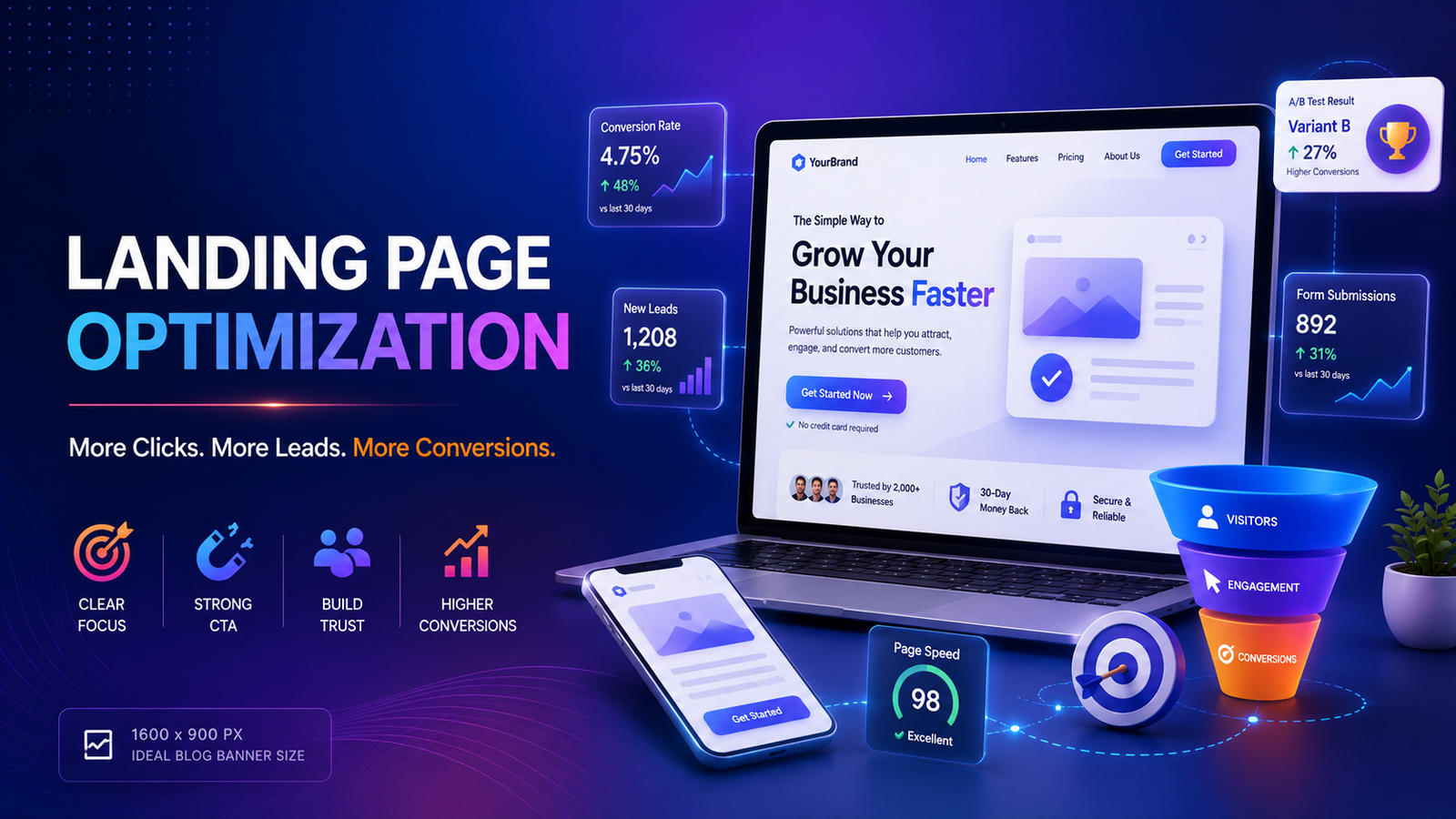
Landing Page Optimization is the process of improving a landing page so more visitors complete a desired action, such as making a purchase, submitting a form, booking a consultation, or signing up for a service. You can have excellent traffic from SEO, Google Ads, social media, or email marketing, but if your landing page doesn’t convince visitors to take action, much of that traffic can go to waste.
Think about it this way: getting visitors to your website is only half the job. Your landing page has to convince them to stay, trust your offer, and take the next step.
For example, if 1,000 people visit your landing page and only 20 convert, your conversion rate is 2%. If strategic improvements increase that rate to 4%, you have doubled your conversions without needing to double your traffic.
That’s why landing page optimization is an important part of Conversion Rate Optimization (CRO).
In this guide, we’ll explain what landing page optimization is, why it matters, and 15 practical ways to create landing pages that turn more visitors into customers.
What Is Landing Page Optimization?
Landing page optimization is the process of analyzing and improving different elements of a landing page to increase conversions.
These elements can include:
- Headlines
- Value propositions
- Images and videos
- Call-to-action buttons
- Forms
- Page layout
- Social proof
- Trust signals
- Product or service information
- Mobile experience
- Page speed
The goal isn’t simply to make a page look better.
The real goal is to remove friction between the visitor and the desired action.
A beautiful landing page that doesn’t generate leads or sales isn’t necessarily a successful landing page.
Why Landing Page Optimization Matters
A landing page is often where a visitor makes an important decision.
They may be deciding whether to:
- Buy your product
- Request a quote
- Book a consultation
- Download a resource
- Start a free trial
- Contact your business
Even small problems can cause visitors to leave.
A confusing headline, slow page, weak CTA, missing trust signals, or complicated form can reduce conversions.
This is why businesses shouldn’t judge a landing page only by its appearance. They should also examine how effectively it moves users toward conversion.
15 Landing Page Optimization Strategies
1. Create a Clear, Benefit-Focused Headline
Your headline is usually one of the first things visitors notice.
It should immediately communicate what you’re offering and why the visitor should care.
Instead of:
“Professional Digital Solutions”
Try something more specific:
Build a High-Converting Shopify Store Without Starting From Scratch
The second version communicates a clearer benefit and target audience.
2. Match the Page With User Intent
Your landing page should deliver what the visitor expected when they clicked.
For example, if your advertisement promotes Shopify store development, sending users to a generic homepage creates unnecessary friction.
The landing page should continue the same message from the advertisement to the page.
This creates a stronger connection between:
Search → Ad → Landing Page → Conversion
3. Make Your Value Proposition Obvious
Visitors should quickly understand:
What do you offer?
Who is it for?
Why should they choose you?
Your value proposition should answer these questions without requiring visitors to search through the page.
4. Use One Primary Call to Action
Too many competing CTAs can create decision fatigue.
If your primary goal is lead generation, make the main action obvious:
Get a Free Consultation
or
Request a Quote
You can still provide secondary navigation, but the primary conversion should be visually and strategically clear.
5. Write CTA Copy That Encourages Action
“Submit” doesn’t tell visitors what happens next.
Instead, use descriptive CTA text such as:
- Get My Free Quote
- Start My Free Trial
- Book a Consultation
- Get Started Today
- Download the Guide
The CTA should communicate the action and, where possible, its benefit.
6. Reduce Form Friction
Every additional form field creates another opportunity for someone to abandon the process.
Ask only for information you actually need.
For example, a simple lead form might initially require:
Name + Email + Business Requirement
You can collect additional information later if necessary.
7. Add Relevant Social Proof
Visitors don’t automatically trust every business they discover online.
Social proof can reduce uncertainty.
Consider adding:
- Customer testimonials
- Reviews
- Case studies
- Client logos
- Ratings
- User-generated content
The strongest social proof is specific and relevant to the offer.
8. Add Trust Signals
Trust signals help answer the visitor’s silent question:
“Is it safe to do business with you?”
Depending on the business, useful trust signals can include:
- Secure payment indicators
- Money-back guarantees
- Clear contact information
- Privacy information
- Industry certifications
- Transparent pricing
- Return policies
Trust should be visible without overwhelming the page.
9. Use Visuals That Support the Message
Images should explain or reinforce the offer, not simply fill empty space.
For an ecommerce landing page, show the product in use.
For a web design service, show real website examples.
For a SaaS product, show the interface.
The visual should help visitors understand what they’re getting.
10. Optimize the Mobile Experience
A landing page that looks excellent on desktop can still perform poorly on mobile.
Check:
- Font size
- Button size
- Form usability
- Image scaling
- Navigation
- Page spacing
- Loading speed
Make sure visitors can complete the conversion action comfortably using their phone.
11. Improve Page Speed
A slow landing page can create friction before visitors even see your offer.
Optimize:
- Images
- Videos
- Scripts
- Fonts
- Third-party tools
- Unnecessary plugins
Performance optimization is particularly important for landing pages receiving paid traffic because you’re paying to bring those visitors to the page.
12. Remove Unnecessary Distractions
Every element on your landing page should have a purpose.
Ask:
Does this element help the visitor understand, trust, or act?
If it doesn’t, consider removing it.
This doesn’t mean every landing page needs to be extremely minimal. It means every element should support the conversion journey.
13. Address Objections Before the CTA
Visitors often have concerns before converting.
For example:
- How much does it cost?
- How long does it take?
- Is there a guarantee?
- What happens after I submit the form?
- Is this suitable for my business?
Use FAQs, guarantees, comparisons, and supporting information to answer these concerns before the final CTA.
This is one of the most overlooked landing page optimization techniques.
14. Use A/B Testing
Don’t assume that the first version of a landing page is the best version.
Test different elements such as:
- Headlines
- CTA copy
- Images
- Form length
- Page layouts
- Social proof
- Offers
For example, you might compare:
Version A: “Get Started”
against
Version B: “Get My Free Consultation”
Then measure which version produces more conversions.
The key is to make decisions based on actual user behavior rather than personal preference.
15. Use Analytics and User Behavior Data
Landing page optimization shouldn’t be based entirely on guesswork.
Use analytics and behavioral tools to understand:
- Where visitors leave
- Which CTAs they click
- How far they scroll
- Which devices they use
- Which traffic sources convert
- Where users encounter friction
Tools such as Google Analytics 4, Microsoft Clarity, and Hotjar can provide useful insights into how people interact with your pages.
Common Landing Page Optimization Mistakes
Even a professionally designed landing page can underperform because of basic mistakes.
Watch for:
- Weak headlines
- Too many CTAs
- Long forms
- Poor mobile design
- Slow loading times
- Generic stock images
- Missing testimonials
- Unclear pricing
- Misleading ad-to-page messaging
- No clear next step
One of the biggest mistakes is changing everything at once without measuring the results.
If you don’t know what changed, you won’t know what actually improved performance.
Landing Page Optimization and CRO: What’s the Difference?
Landing page optimization is closely connected to Conversion Rate Optimization, but they aren’t the same.
CRO is the broader discipline of improving conversion performance across a website or digital funnel.
Landing page optimization focuses specifically on improving landing pages.
Think of it this way:
CRO is the larger strategy. Landing page optimization is one of the most important parts of that strategy.
This distinction also gives us a natural internal connection to your CRO article.
How to Build a High-Converting Landing Page
A practical landing page structure could look like this:
Landing Page Optimization isn’t about making a page look impressive. It’s about making the path from visitor to customer easier.
A strong landing page tells visitors what you’re offering, explains why it matters, builds trust, removes objections, and makes the next step obvious.
Start with the fundamentals: clear messaging, relevant content, strong CTAs, trust signals, mobile usability, and fast performance. Then use analytics and A/B testing to discover what your audience actually responds to.
And remember: you don’t always need more traffic to grow. Sometimes, the biggest opportunity is already sitting on your website.
Get more from the visitors you already have.
Headline
↓
Clear value proposition
↓
Relevant visual
↓
Primary CTA
↓
Benefits
↓
Social proof
↓
Product/service details
↓
Objection handling / FAQs
↓
Trust signals
↓
Final CTA
The exact structure will depend on your audience, offer, and conversion goal.
Final Thoughts
Landing Page Optimization isn’t about making a page look impressive. It’s about making the path from visitor to customer easier.
A strong landing page tells visitors what you’re offering, explains why it matters, builds trust, removes objections, and makes the next step obvious.
Start with the fundamentals: clear messaging, relevant content, strong CTAs, trust signals, mobile usability, and fast performance. Then use analytics and A/B testing to discover what your audience actually responds to.
And remember: you don’t always need more traffic to grow. Sometimes, the biggest opportunity is already sitting on your website.
Get more from the visitors you already have.
Frequently Asked Questions
What is landing page optimization?
Landing page optimization is the process of improving a landing page’s content, design, usability, and conversion elements to encourage more visitors to complete a desired action.
Why is landing page optimization important?
It helps businesses get more value from existing traffic by improving the percentage of visitors who become leads, customers, subscribers, or users.
What makes a landing page high converting?
A clear value proposition, relevant content, strong CTA, social proof, trust signals, fast performance, and a simple user experience can all contribute to higher conversions.
How do I know if my landing page needs optimization?
Look at conversion rates, traffic sources, user behavior, form abandonment, device performance, and where visitors leave the page. These signals can reveal potential friction.
Is landing page optimization part of CRO?
Yes. Landing page optimization is one component of the broader Conversion Rate Optimization process.
How long does landing page optimization take?
Some improvements can be implemented quickly, while meaningful optimization requires ongoing testing and analysis. The timeline depends on traffic volume, the number of changes, and the complexity of the conversion funnel.