
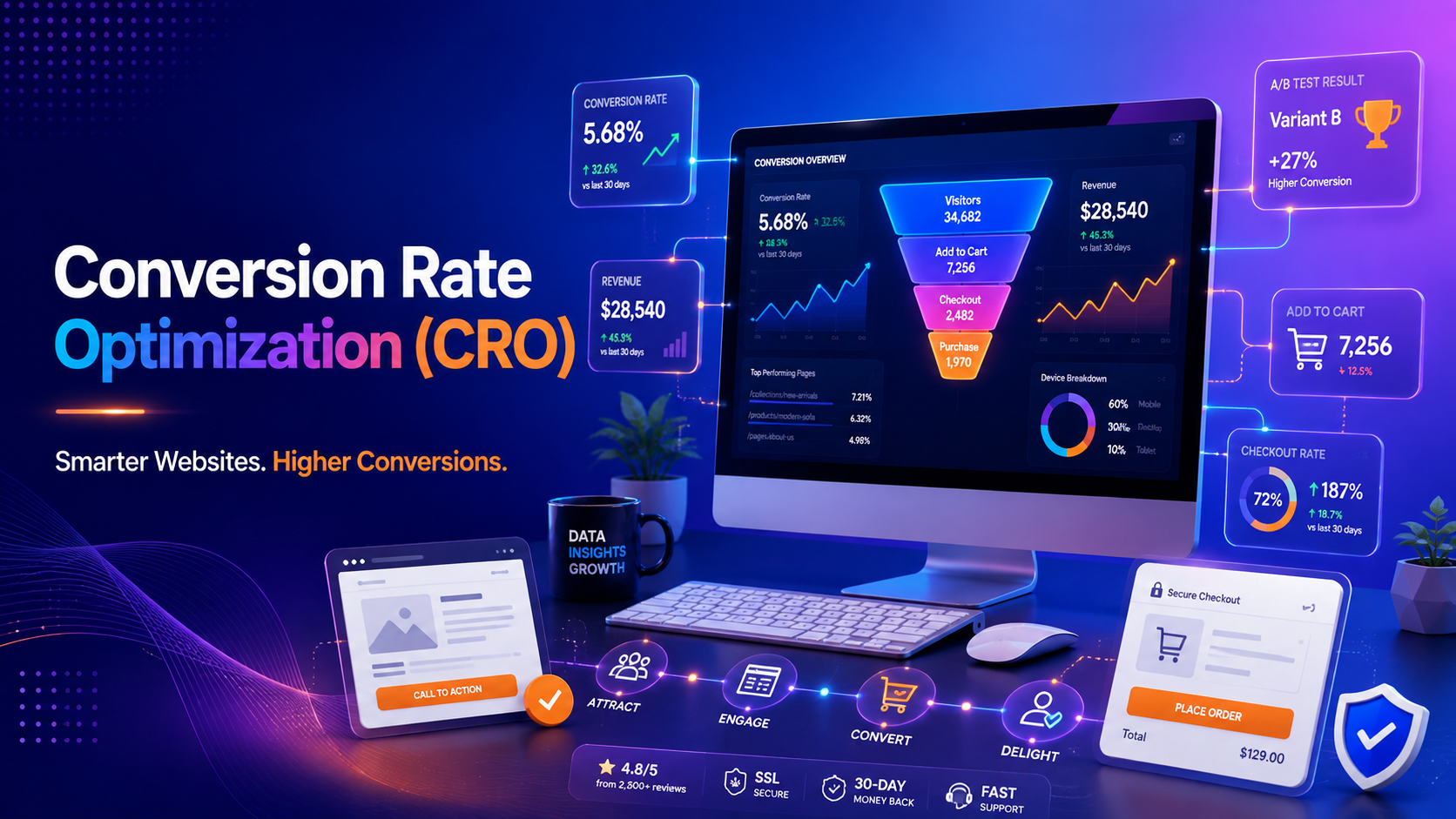
Conversion Rate Optimization (CRO) is the process of improving your website so that more visitors take meaningful actions, such as making a purchase, filling out a contact form, subscribing to a newsletter, or booking a consultation. While many businesses focus heavily on driving more traffic through SEO or paid advertising, they often overlook a much bigger opportunity: converting the visitors they already have.
Imagine two businesses each receiving 10,000 monthly visitors. One converts only 2% of those visitors, while the other converts 5%. Without spending an extra dollar on marketing, the second business generates more than twice the number of customers simply because its website converts better.
That’s the power of CRO.
Instead of asking, “How can I get more traffic?”, Conversion Rate Optimization asks a smarter question:
“How can I get more value from every visitor who already comes to my website?”
In this guide, you’ll learn what CRO is, why it matters, how to calculate your conversion rate, and 18 proven techniques to increase conversions, improve user experience, and grow your business.
What Is Conversion Rate Optimization (CRO)?
Conversion Rate Optimization (CRO) is the practice of improving your website, landing pages, and user experience to increase the percentage of visitors who complete a desired action.
A conversion can be:
- Purchasing a product
- Submitting a contact form
- Booking a demo
- Signing up for a newsletter
- Downloading an eBook
- Creating an account
Rather than focusing solely on attracting more visitors, CRO helps businesses maximize the value of their existing traffic.
How to Calculate Conversion Rate
The formula is simple:
Conversion Rate = (Conversions ÷ Total Visitors) × 100
For example:
- Website Visitors: 2,000
- Conversions: 100
Conversion Rate = 5%
Even a small improvement, from 2% to 3%, can significantly increase leads and revenue over time.
Why Conversion Rate Optimization Matters
Many businesses believe that increasing website traffic is the fastest way to grow revenue. While traffic is important, it doesn’t guarantee sales.
Imagine spending thousands of dollars on Google Ads or SEO to attract visitors, only to lose potential customers because your website loads slowly, your call to action isn’t clear, or your checkout process is confusing.
That’s where CRO makes the biggest difference.
Here’s why CRO matters:
- Maximizes the return on your marketing investment.
- Increases revenue without increasing advertising costs.
- Improves user experience.
- Reduces customer acquisition costs (CAC).
- Builds trust and credibility.
- Encourages repeat visitors and long-term customer loyalty.
Insight: More traffic doesn’t always mean more sales. In many cases, improving your website’s conversion rate delivers a higher return than investing in additional traffic.
18 Proven Conversion Rate Optimization Techniques
1. Improve Website Speed
Users expect pages to load quickly. A slow website increases bounce rates and reduces conversions. Compress images, enable browser caching, and optimize your site’s performance.
2. Create a Clear Value Proposition
Within a few seconds, visitors should understand:
- What you offer
- Who it’s for
- Why they should choose you
Clear messaging reduces confusion and builds confidence.
3. Use Strong Call-to-Action (CTA) Buttons
Generic buttons like “Submit” don’t encourage action.
Instead, use action-oriented CTAs such as:
- Get Started
- Book a Free Consultation
- Download the Guide
- Start Your Free Trial
4. Reduce Form Fields
Long forms discourage users.
Only ask for information you truly need.
Shorter forms often generate more leads.
5. Optimize for Mobile Users
Most website traffic now comes from mobile devices.
Ensure your website offers:
- Responsive design
- Easy navigation
- Clickable buttons
- Fast loading pages
6. Build Trust with Social Proof
People trust other customers more than marketing messages.
Add:
- Customer reviews
- Testimonials
- Ratings
- Case studies
- Client logos
7. Improve Landing Pages
Every landing page should focus on one goal.
Avoid unnecessary distractions and guide visitors toward a single conversion action.
8. Use High-Quality Images and Videos
Professional visuals improve credibility and help visitors understand your products or services faster.
9. Simplify Website Navigation
Visitors shouldn’t have to search for important information.
Organize menus logically and make essential pages easy to find.
10. Remove Unnecessary Distractions
Too many pop-ups, banners, or animations can overwhelm users.
Keep your design clean and focused.
11. Personalize the User Experience
Show relevant content, recommendations, or offers based on user behavior whenever possible.
12. Use Urgency and Scarcity Ethically
Limited-time offers, countdown timers, or low-stock notifications can encourage action, but only when genuine.
13. Optimize Product or Service Pages
Include:
- Detailed descriptions
- Benefits
- Pricing clarity
- FAQs
- High-quality visuals
- Customer reviews
14. Improve Readability
Use:
- Short paragraphs
- Clear headings
- Bullet points
- White space
Easy-to-read content keeps visitors engaged.
15. Perform A/B Testing
Test different versions of:
- Headlines
- CTA buttons
- Images
- Layouts
- Colors
- Forms
Even small improvements can increase conversions.
16. Use Heatmaps and Session Recordings
Tools like Microsoft Clarity and Hotjar help you understand how visitors interact with your website and where they encounter friction.
17. Track User Behavior with Analytics
Monitor metrics such as:
- Bounce rate
- Conversion rate
- Average engagement time
- Exit pages
- Funnel drop-offs
Data-driven decisions produce better results than guesswork.
18. Continuously Optimize
CRO isn’t a one-time project.
Consumer behavior, technology, and market trends change over time. Regular testing and optimization ensure your website continues to perform at its best.
Common CRO Mistakes to Avoid
Even well-designed websites can lose conversions because of simple mistakes.
Avoid these common issues:
- Slow-loading pages
- Weak or unclear CTAs
- Complicated navigation
- Too many pop-ups
- Long checkout processes
- Ignoring mobile users
- Not testing changes before implementation
- Making decisions without analytics
Best CRO Tools
These tools can help you improve your website’s conversion rate:
- Google Analytics 4 – Track user behavior and conversions.
- Microsoft Clarity – Free heatmaps and session recordings.
- Hotjar – User behavior insights and feedback.
- VWO – A/B testing and experimentation.
- Optimizely – Enterprise-level testing and personalization.
Choose tools based on your business size and optimization goals.
Final Thoughts
Conversion Rate Optimization isn’t about attracting more visitors, it’s about helping more of your existing visitors become customers. Every improvement, whether it’s a faster website, clearer messaging, or a stronger call-to-action, contributes to a better user experience and better business results.
The most successful businesses don’t rely on guesswork. They test, measure, learn, and continuously improve their websites based on real user behavior.
If you’re already investing in SEO, Google Ads, or social media marketing, CRO is the missing piece that helps you maximize every visitor and turn traffic into measurable growth.
Frequently Asked Questions
What is a good conversion rate?
A good conversion rate varies by industry, but many websites aim for 2% to 5%. High-performing websites often achieve even higher rates through continuous optimization.
Is CRO better than SEO?
CRO and SEO serve different purposes. SEO helps bring visitors to your website, while CRO helps convert those visitors into customers. The best results come from combining both.
How long does CRO take?
Some improvements, such as simplifying forms or improving CTAs, can deliver results within weeks. More advanced optimization requires ongoing testing and analysis.
Can small businesses benefit from CRO?
Absolutely. Even small increases in conversion rates can significantly improve revenue without increasing marketing spend.
Which CRO tool should I start with?
If you’re just getting started, Google Analytics 4 and Microsoft Clarity provide valuable insights and are excellent starting points.