
Introduction
Imagine two websites that both use the keyword “SEO Agency“ ten times on a page. One ranks on the first page of Google, while the other struggles to appear in search results. Why?
The answer often lies beyond keywords. Search engines have evolved from simply matching words to understanding entities: people, places, organizations, products, and concepts mentioned within your content.
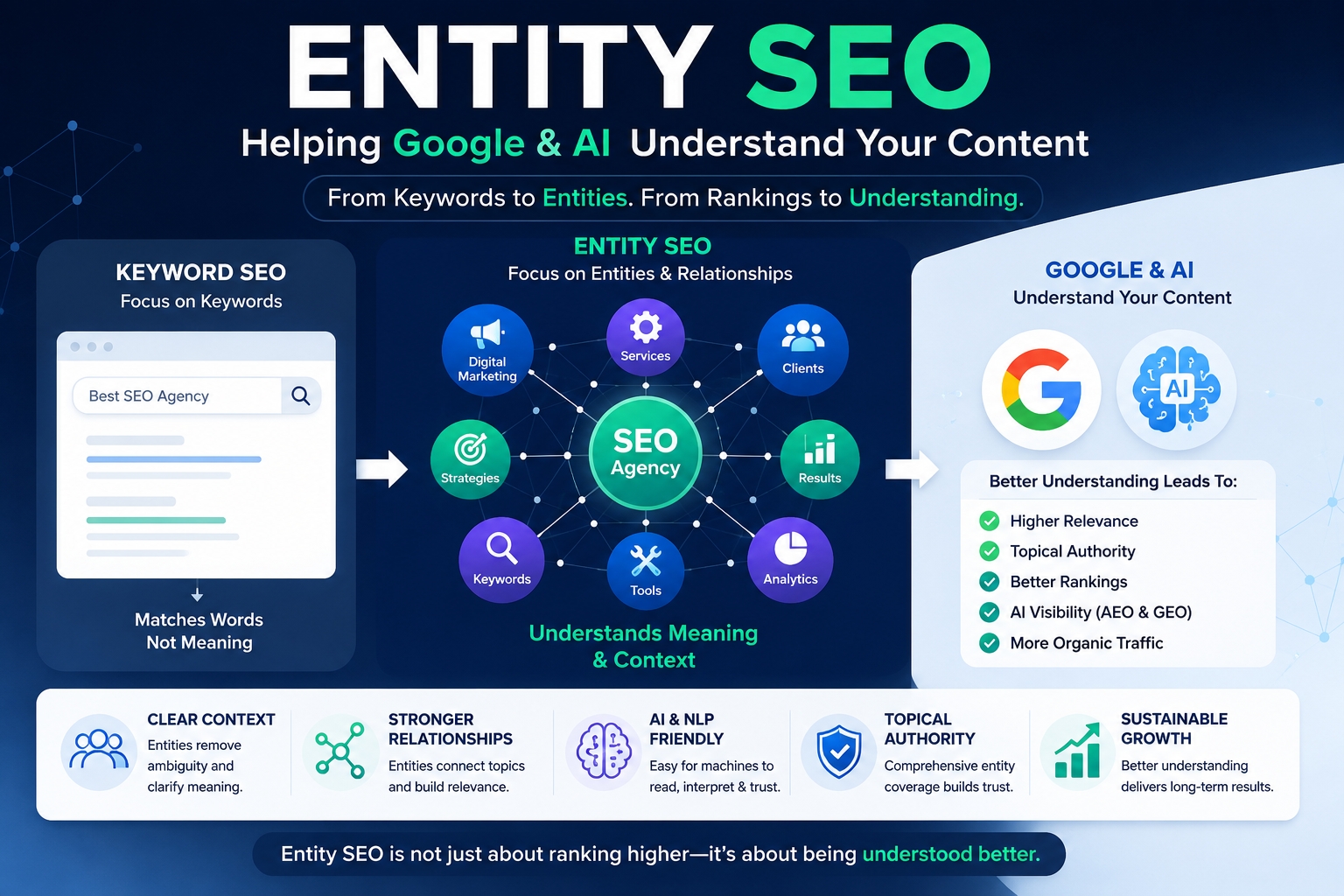
Entity SEO is the process of optimizing your content around these recognizable concepts so that Google and AI-powered search engines can better understand what your page is about. Instead of relying only on keyword repetition, Entity SEO helps search engines connect your content to the broader web of knowledge, making it more relevant, trustworthy, and easier to recommend.
As AI search experiences continue to grow in 2026, understanding Entity SEO has become one of the most valuable skills for marketers, businesses, and content creators.
What Is Entity SEO?
Entity SEO is the practice of optimizing content around clearly identifiable concepts (called entities) rather than focusing only on exact-match keywords.
An entity is anything that has a unique identity.
Examples include:
- Apple Inc.
- Shopify
- New York City
- Cristiano Ronaldo
- Search Engine Optimization
- Meta Pixel
Unlike keywords, entities have meaning regardless of the exact words used.
For example:
“Apple launched a new iPhone.”
Google understands that Apple refers to the technology company, not the fruit, because it recognizes the surrounding entities like iPhone, iOS, and Tim Cook.
That ability to understand meaning is what makes Entity SEO so powerful.
Why Keywords Alone Are No Longer Enough
Years ago, search engines mainly relied on matching keywords.
If someone searched:
Best SEO agency
Google looked for pages containing those exact words.
Today, Google asks much smarter questions.
Instead of asking:
Does this page contain the keyword?
It asks:
- What is this page actually about?
- Which entities are mentioned?
- How are these entities related?
- Does the content answer the user’s intent?
- Can this information be trusted?
This shift is why simply repeating keywords no longer guarantees rankings.
Understanding Entities with a Simple Example
Imagine you read this sentence:
Pixel helps businesses.
What does “Pixel” mean?
- Google Pixel?
- Image pixel?
- Meta Pixel?
The sentence is unclear.
Now read this:
Meta Pixel helps businesses track website visitors by collecting browser-side events.
Now the meaning becomes obvious.
Google understands:
- Meta → Company
- Meta Pixel → Tracking tool
- Website visitors → Audience
- Browser-side events → Technology
By removing ambiguity, you’ve made it easier for both humans and search engines to understand your content.
How Google Understands Entities
Google doesn’t read webpages the way humans do.
Instead, it uses Natural Language Processing (NLP) to identify important concepts and the relationships between them.
Imagine your page says:
Shopify helps businesses create online stores.
Google identifies:
- Shopify → Company
- Online Stores → Concept
- Businesses → Audience
Then it connects these relationships with information it already knows from its Knowledge Graph.
Instead of seeing random words, Google sees connected ideas.
This is why your content should focus on meaningful relationships rather than isolated keywords.
Entity SEO vs Keyword SEO
| Keyword SEO | Entity SEO |
| Focuses on exact words | Focuses on concepts and meaning |
| Relies on keyword density | Relies on context and relationships |
| Optimizes for search terms | Optimizes for understanding |
| Can create repetitive content | Encourages natural writing |
| Limited context | Rich semantic context |
Keyword research still matters.
Entity SEO simply takes your optimization one step further.
Why Entity SEO Matters in 2026
Search engines are becoming increasingly intelligent.
Google’s AI Overviews and conversational AI platforms don’t just search for keywords, they retrieve knowledge.
That means content built around well-defined entities is more likely to:
- Be understood correctly
- Match search intent
- Support AI-generated answers
- Build topical authority
- Improve long-term organic visibility
In short, Entity SEO helps future-proof your content.
Real-World Example
Imagine two articles about Shopify.
Article A
Repeats:
- Shopify Theme
- Shopify Store
- Shopify Design
without much explanation.
Article B
Explains:
- Shopify
- Liquid
- Online Store 2.0
- Product Templates
- Collection Pages
- Metaobjects
- Shopify App Store
The second article naturally demonstrates deeper expertise because it covers the ecosystem surrounding Shopify, not just the keyword.
That’s Entity SEO in action.
How Entity SEO Supports Semantic SEO
Semantic SEO focuses on covering a topic comprehensively.
Entity SEO provides the building blocks.
For example, if you’re writing about Technical SEO, your content might naturally include entities such as:
- XML Sitemap
- Robots.txt
- Core Web Vitals
- Crawl Budget
- Canonical Tags
- Structured Data
- HTTPS
These related entities help Google understand the depth of your expertise.
Entity SEO and Google’s Knowledge Graph
One of Google’s most powerful systems is its Knowledge Graph.
Think of it as a massive database of connected information.
Instead of storing isolated facts, it stores relationships.
For example:
↓
Owns
↓
YouTube
Or:
Meta
↓
Developed
↓
Meta Pixel
When your content accurately references recognized entities, Google can more confidently connect your page with its existing knowledge.
How Entity SEO Supports AEO & GEO
As AI-powered search continues to grow, Entity SEO plays an even bigger role.
AI systems need content that is:
- Easy to understand
- Rich in context
- Clearly structured
- Free from ambiguity
Entities help AI quickly identify:
- Who
- What
- Where
- How
- Relationships between concepts
This improves the chances of your content being used when AI generates answers to user queries.
Rather than optimizing only for rankings, Entity SEO also optimizes your content for machine understanding.
Entity SEO Checklist
Before publishing your content, ask yourself:
✅ Have I clearly defined the main topic?
✅ Are important people, brands, products, and concepts identified?
✅ Have I used the full names of entities where appropriate?
✅ Does the content naturally include related entities?
✅ Are headings descriptive and specific?
✅ Have I answered the user’s search intent directly?
✅ Have I added examples that remove ambiguity?
✅ Is the content easy for both humans and AI to understand?
Common Entity SEO Mistakes
Many websites unknowingly make these mistakes:
- Stuffing keywords instead of explaining concepts
- Using vague terms without context
- Ignoring related entities
- Writing shallow content
- Covering only one aspect of a topic
- Forgetting internal links to related content
- Publishing generic AI-generated articles without original insights
Avoiding these mistakes can significantly improve the quality of your content.
The Future of SEO Is About Understanding
Traditional SEO asked:
How can I rank for this keyword?
Modern SEO asks:
How can I become the most trusted source of knowledge on this topic?
That’s a fundamental shift.
Instead of writing pages for search engines, you’re creating content that helps both humans and AI understand your expertise.
Frequently Asked Questions
Does Entity SEO replace keyword research?
No. Keywords help you discover what people search for, while entities help search engines understand what your content means. Both work best together.
How do I identify entities in my content?
Look for important people, brands, products, places, technologies, and concepts directly related to your topic. These often become the core entities of your page.
Is Entity SEO important for AI search?
Yes. AI systems rely on context and relationships to generate accurate answers. Clearly defined entities make your content easier to interpret and retrieve.
Does Entity SEO improve Google rankings?
Entity SEO isn’t a direct ranking factor, but it helps search engines better understand your content. Better understanding can support stronger relevance and visibility over time.
What’s the difference between Entity SEO and Semantic SEO?
Entity SEO focuses on the identifiable concepts within your content. Semantic SEO focuses on covering the topic comprehensively and showing how those concepts relate to one another.
Can small businesses benefit from Entity SEO?
Absolutely. Whether you’re a local business, an eCommerce store, or a digital agency, using clear entities and comprehensive content can improve how search engines understand your website.
Final Thoughts
Search engines have evolved far beyond counting keywords. Today, success comes from helping machines understand meaning.
Entity SEO is the foundation of that understanding. By clearly identifying important concepts, connecting related topics, and writing content that answers real user questions, you create pages that are valuable to both people and AI systems.
As search continues to evolve in 2026 and beyond, websites that focus on clarity, context, and expertise will be in the strongest position to earn visibility, not just in traditional search results, but also in AI-powered search experiences.