
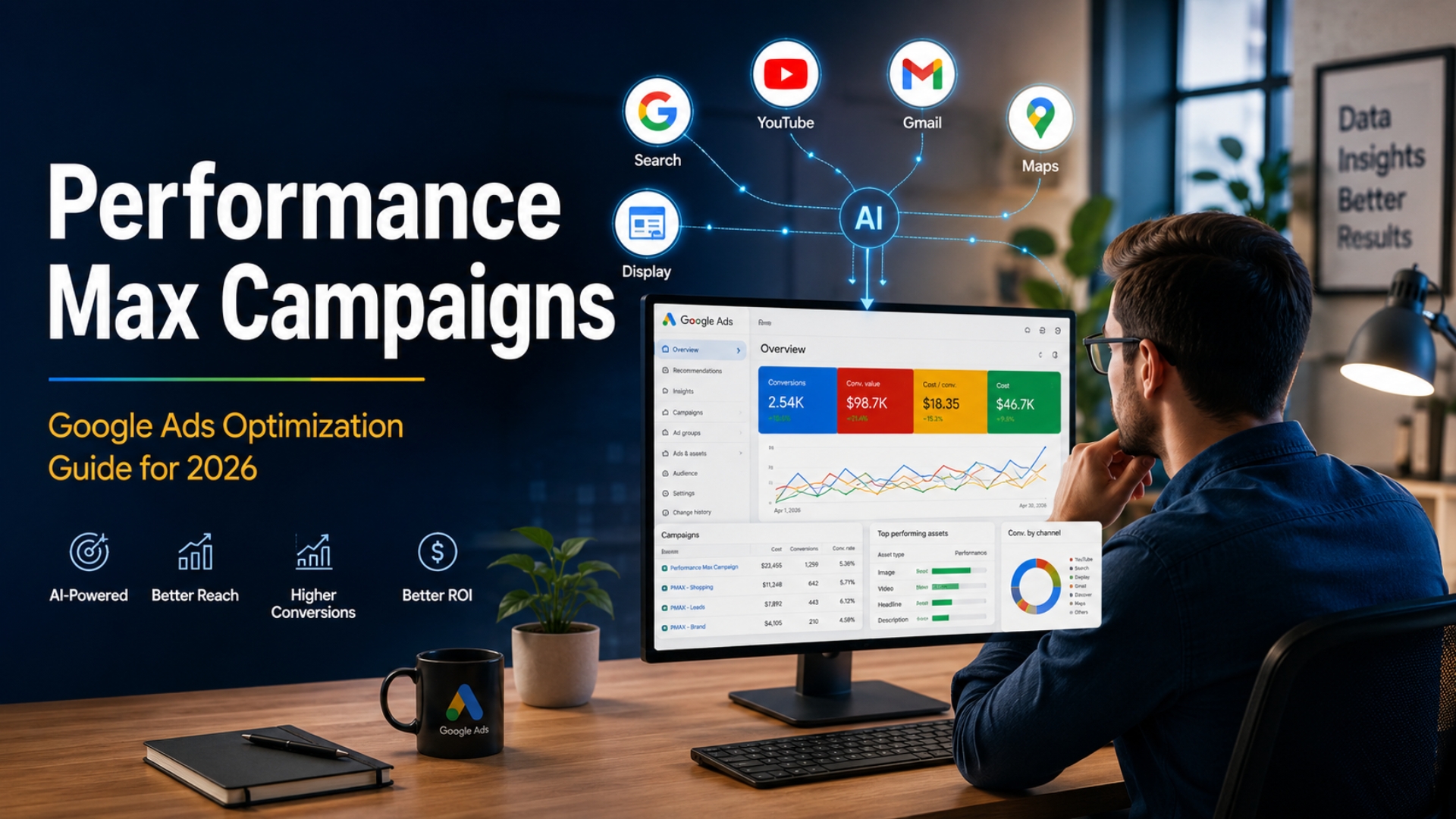
Running Google Ads today is very different from what it was just a few years ago.
Advertisers once had full control over keywords, bidding strategies, audience targeting, and placements. Today, Google is increasingly relying on artificial intelligence to make those decisions automatically. At the center of this shift is Performance Max Campaigns, Google’s AI-powered campaign type designed to help businesses reach customers across all Google channels from a single campaign.
For some businesses, Performance Max has become a powerful growth engine. For others, it has become a source of frustration due to poor visibility, weak conversions, and rising costs.
The difference usually comes down to strategy.
In this guide, you’ll learn what Performance Max Campaigns are, why they matter in 2026, common mistakes businesses make, and how to optimize them for better results.
What Are Performance Max Campaigns?
Performance Max Campaigns (often called PMax) are a goal-based Google Ads campaign type that uses machine learning to show ads across Google’s entire network.
Instead of creating separate campaigns for different platforms, Google automatically distributes your ads across:
- Google Search
- YouTube
- Display Network
- Gmail
- Discover
- Google Maps
- Shopping
You provide creative assets, audience signals, conversion goals, and budget. Google’s AI then determines where, when, and to whom your ads should be shown.
Think of Performance Max as Google’s attempt to automate media buying while maximizing conversions.
Why Performance Max Campaigns Matter in 2026
Google’s advertising ecosystem is becoming increasingly AI-driven.
As competition grows and user behavior becomes more complex, manually managing every aspect of a campaign becomes less practical.
Performance Max matters because it helps advertisers:
- Reach customers across multiple channels
- Discover new audiences
- Automate bidding decisions
- Improve conversion opportunities
- Scale campaigns faster
More importantly, Google continues investing heavily in automation and AI-powered advertising, making Performance Max one of its flagship campaign types.
For businesses that understand how to use it correctly, it can unlock significant growth opportunities.
How Performance Max Campaigns Work
Unlike traditional campaigns, Performance Max doesn’t rely solely on keywords.
Instead, Google analyzes:
- Audience signals
- Search intent
- User behavior
- Historical performance
- Creative assets
- Conversion data
The system then predicts which users are most likely to complete your desired action.
For example, if you run an eCommerce store selling fitness equipment, Google may show your ads to users who:
- Search for home gym equipment
- Watch fitness videos on YouTube
- Browse health-related content
- Compare exercise products online
All of this happens automatically through machine learning.
Performance Max vs Search Campaigns
One of the biggest questions advertisers ask is whether Performance Max is better than traditional Search Campaigns.
The answer depends on your goals.
| Feature | Performance Max | Search Campaigns |
| Keyword Control | Limited | High |
| Automation | High | Moderate |
| Audience Expansion | Excellent | Limited |
| Channel Reach | Multiple Google Networks | Search Only |
| Transparency | Lower | Higher |
| AI Optimization | Strong | Moderate |
Search Campaigns still work extremely well for high-intent searches.
Performance Max works best when businesses want broader reach and are comfortable allowing Google’s AI to make optimization decisions.
Many successful advertisers use both campaign types together.
Search Intent Coverage: Who Should Use Performance Max?
Performance Max isn’t ideal for every situation.
It works particularly well for:
eCommerce Businesses
Online stores often benefit from automated product promotion across multiple Google properties.
Local Service Businesses
Businesses such as dentists, gyms, real estate agencies, and home service providers can expand visibility beyond traditional search.
Lead Generation Companies
When proper conversion tracking is implemented, Performance Max can identify new opportunities that manual campaigns may miss.
Brands Looking to Scale
Businesses seeking growth across multiple channels often see stronger reach with Performance Max.
Fan-Out Questions: What Businesses Really Want to Know
When users search for Performance Max Campaigns, they often have several related questions.
Let’s answer the most common ones.
Does Performance Max Replace Search Campaigns?
No.
Search Campaigns remain valuable for targeting specific keywords and maintaining greater control.
How Long Does Performance Max Take to Work?
Most campaigns require several weeks of data collection before Google’s machine learning can optimize effectively.
Can Small Businesses Use Performance Max?
Yes, provided conversion tracking is configured correctly and there is sufficient data for optimization.
Is Performance Max Good for eCommerce?
Absolutely. Many eCommerce businesses use Performance Max to manage Shopping ads, display ads, and remarketing efforts within a single campaign.
Real-World Example
Imagine two online furniture stores.
Store A
- Uses only Search Campaigns
- Targets a limited set of keywords
- Reaches customers primarily through Google Search
Store B
- Uses Performance Max Campaigns
- Provides strong audience signals
- Uploads high-quality creative assets
- Tracks conversions accurately
Store B may appear across:
- Search
- YouTube
- Gmail
- Shopping
- Display Network
As a result, it can reach customers at multiple stages of the buying journey.
This broader visibility often creates additional conversion opportunities.
Common Performance Max Campaign Mistakes
Many businesses assume Performance Max will automatically generate results.
Unfortunately, a poor setup often leads to disappointing performance.
Weak Conversion Tracking
Google’s AI relies heavily on conversion data.
If conversion tracking is inaccurate, optimization suffers.
Poor Creative Assets
Low-quality images, weak headlines, and generic descriptions limit campaign performance.
Ignoring Audience Signals
Audience signals help Google’s machine learning understand where to start.
Without them, learning periods can become longer and less efficient.
Sending Traffic to Weak Landing Pages
Even the best campaigns struggle when visitors arrive on slow or poorly designed landing pages.
Making Changes Too Frequently
Machine learning requires time.
Constant adjustments can reset learning and negatively impact performance.
Performance Max Optimization Framework
Use this checklist before launching or scaling a campaign.
Step 1: Set Up Accurate Conversion Tracking
Track:
- Purchases
- Leads
- Calls
- Form submissions
Without reliable tracking, optimization becomes guesswork.
Step 2: Build Strong Audience Signals
Include:
- Customer lists
- Website visitors
- Relevant interests
- In-market audiences
These signals help Google’s AI find similar users.
Step 3: Improve Creative Assets
Provide:
- Multiple headlines
- High-quality images
- Professional videos
- Clear calls-to-action
More asset variety gives Google’s system additional optimization options.
Step 4: Optimize Landing Pages
Ensure pages are:
- Fast-loading
- Mobile-friendly
- Easy to navigate
- Conversion-focused
Campaign success often depends on post-click experience.
Step 5: Monitor Search Themes and Insights
Review campaign insights regularly to understand:
- Emerging trends
- Audience behavior
- Search intent patterns
This helps guide future optimization efforts.
How AI Is Changing Performance Max Campaigns
Performance Max is one of the clearest examples of AI-powered advertising.
Google’s machine learning now influences:
- Bidding decisions
- Audience targeting
- Ad placements
- Creative combinations
- Budget allocation
As AI continues evolving, advertisers will spend less time managing individual settings and more time providing strategic inputs.
The businesses that succeed will be those that give Google’s AI better data, stronger creative assets, and clearer business objectives.
FAQs
Are Performance Max Campaigns worth it?
Yes, when conversion tracking, audience signals, and creative assets are properly configured.
Do Performance Max Campaigns use keywords?
Not in the traditional sense. Google primarily uses audience signals, search intent, and machine learning to determine targeting.
Are Performance Max Campaigns good for local businesses?
Yes. Local businesses can benefit from expanded visibility across Google’s network.
How long should I wait before optimizing a Performance Max Campaign?
Allow sufficient time for learning and data collection before making major changes.
Can Performance Max Campaigns replace all other Google Ads campaigns?
No. Many advertisers achieve the best results by combining Performance Max with Search Campaigns and other campaign types.
What is the biggest mistake businesses make with Performance Max?
Launching campaigns without proper conversion tracking and expecting automation to solve every problem.
Final Thoughts
Performance Max Campaigns represent the future direction of Google Ads.
Rather than focusing solely on keywords, they use machine learning, audience data, and cross-channel advertising to identify conversion opportunities across Google’s ecosystem.
However, automation does not eliminate the need for strategy.
Businesses that invest in accurate tracking, strong creative assets, audience insights, and optimized landing pages are far more likely to see meaningful results.
In 2026, successful advertising isn’t about giving Google complete control, it’s about providing the right inputs so Google’s AI can make smarter decisions on your behalf.