
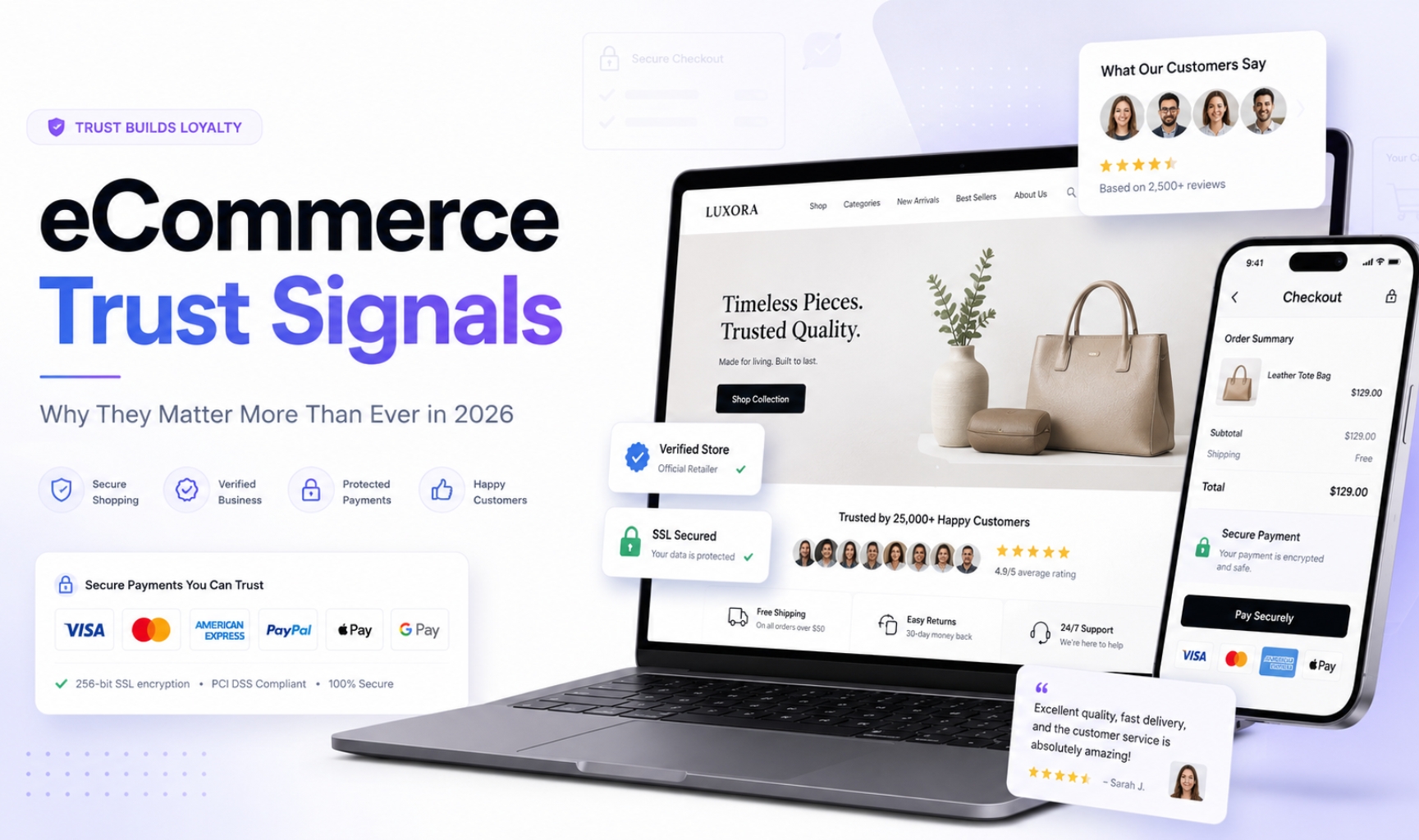
Trust has become one of the most important factors in eCommerce.
Customers today have endless options. They can compare products, prices, and brands within seconds. That means online stores are no longer competing only on products; they are competing on confidence.
The reality is simple: if a website does not feel trustworthy, most users leave before making a purchase.
This is where eCommerce Trust Signals become important.
From design choices and website speed to customer reviews and checkout experience, every detail influences how users feel while shopping online. In many cases, trust is what separates a high-converting store from one that struggles to retain customers.
In 2026, building trust online is no longer optional. It has become part of the customer experience itself.
What Are eCommerce Trust Signals?
eCommerce Trust Signals are elements that help users feel safe, comfortable, and confident while interacting with an online store.
These signals can be:
- Visual
- Technical
- Psychological
- Behavioral
The purpose of trust signals is to reduce hesitation during the buying process.
When customers trust a website, they are more likely to:
- Browse longer
- Explore products
- Add items to cart
- Complete purchases
Without trust, even good products can struggle to sell.
First Impressions Shape Trust Immediately
Most users form an opinion about a website within a few seconds.
Before reading product descriptions or comparing prices, customers are already judging:
- Design quality
- Professionalism
- Layout structure
- Brand consistency
A cluttered or outdated design often creates uncertainty immediately.
Modern eCommerce websites are moving toward:
- Cleaner layouts
- Better spacing
- Simpler navigation
- More organized content
These design decisions make websites feel more reliable and easier to use.
Website Speed Influences Customer Confidence
Speed is not only a technical factor anymore. It also affects perception.
When a website loads slowly, users often associate it with:
- Poor reliability
- Lower professionalism
- Potential security concerns
Fast websites create smoother experiences and help customers feel more comfortable interacting with the store.
In modern eCommerce, performance has become part of trust itself.
Businesses are increasingly optimizing:
- Image sizes
- Mobile performance
- Hosting quality
- Lightweight page structures
Even small speed improvements can positively affect customer behavior.
Mobile Experience Plays a Major Role
Most online shoppers now browse directly from mobile devices.
If a website feels difficult to navigate on mobile, trust drops quickly.
Strong mobile-focused experiences usually include:
- Responsive layouts
- Easy-to-read text
- Simple navigation
- Smooth checkout flows
- Fast-loading pages
Customers expect mobile experiences to feel just as polished as desktop versions.
When mobile usability feels inconsistent, many users leave without returning.
Customer Reviews Continue to Influence Buying Decisions
Reviews remain one of the strongest eCommerce Trust Signals.
Before purchasing, many customers actively look for:
- Ratings
- Customer feedback
- Product experiences
- Social proof
Reviews help reduce uncertainty because they provide reassurance from other buyers.
Authentic reviews often create more confidence than promotional marketing language.
Modern stores are also presenting reviews more strategically through:
- Verified purchase labels
- Customer photos
- Video testimonials
- Review summaries
These elements make websites feel more transparent and credible.
Clear Branding Creates a Stronger Sense of Reliability
Consistency matters more than many businesses realize.
Strong branding helps users feel that a store is established and professional.
This includes:
- Consistent typography
- Matching colors
- Professional product imagery
- Clear messaging
- Cohesive design structure
When branding feels inconsistent or unfinished, users may question the legitimacy of the business itself.
Good branding does not always need to feel luxurious. It simply needs to feel intentional and trustworthy.
Checkout Experience Can Build or Break Trust
Customers often decide whether they fully trust a store during checkout.
Complicated forms, unexpected costs, or unclear payment processes create hesitation immediately.
Modern checkout experiences focus on:
- Simplicity
- Transparency
- Minimal distractions
- Clear payment options
Trust-building checkout elements often include:
- Secure payment badges
- Guest checkout options
- Transparent shipping details
- Easy return information
The easier and safer the checkout feels, the higher the likelihood of conversion.
Professional Product Pages Matter More Than Ever
Product pages are where customers spend the most time evaluating trust.
Strong product pages usually provide:
- High-quality visuals
- Accurate descriptions
- Clear pricing
- Shipping information
- Return details
Customers want enough information to feel confident before making a decision.
Modern eCommerce Trust Signals also include:
- Size guides
- FAQs
- Customer photos
- Real-life product usage
The goal is to remove uncertainty before checkout begins.
Human-Centered Design Is Becoming More Important
One noticeable shift in 2026 is the movement toward more human-centered online experiences.
Customers are responding better to websites that feel:
- Authentic
- Relatable
- Less overly corporate
Many brands are using:
- Real photography
- Softer visual styles
- More natural messaging
- Cleaner storytelling
Some businesses also study modern store structures and UX approaches through platforms like creatorstudio99 to better understand how visually clean and trust-focused online experiences are built today.
The focus is shifting away from aggressive design toward experiences that feel more comfortable and genuine.
Trust Is Closely Connected to User Experience
Trust and UX are no longer separate conversations.
Customers naturally trust websites that:
- Feel easy to use
- Load quickly
- Look professional
- Provide clarity
- Reduce friction
In many ways, strong UX design becomes a trust signal itself.
The smoother the experience feels, the more confident users become while shopping.
Final Thoughts
Building trust online has become one of the most important parts of running a successful eCommerce business.
Modern eCommerce Trust Signals go far beyond badges and reviews. They now include:
- Website speed
- Mobile usability
- Design quality
- Checkout simplicity
- Brand consistency
- Overall user experience
Customers may not consciously analyze every detail, but they notice how a website makes them feel.
In 2026, the stores that build confidence quickly are often the ones that convert more effectively and create stronger long-term customer relationships.